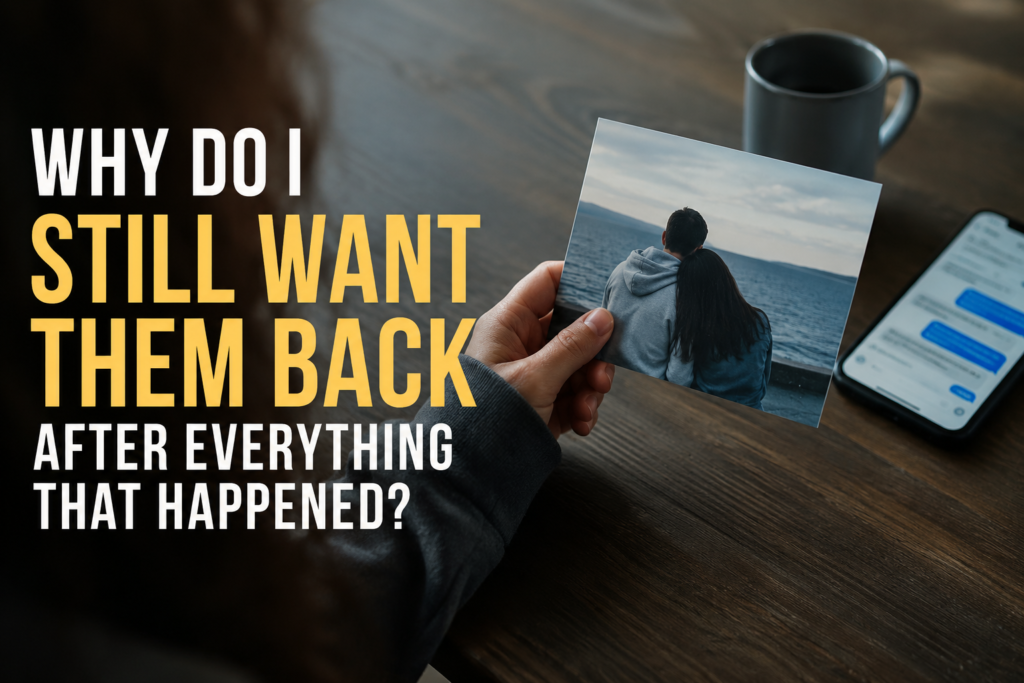
When you have lived through addiction with someone you love, it can be surprisingly difficult to reconcile what you know with what you feel. You can remember the lies, the broken promises, the worry, the arguments, the financial strain, the uncertainty and all the times you thought, I cannot keep living like this — and still find yourself missing them.
You may have separated, asked them to leave, changed the way you respond to them, or created more distance between their addiction and your daily life. Perhaps they are in recovery now. Perhaps they are still using. Perhaps you do not even know what will happen next. Whatever the circumstances, there may still be moments when you want the person back, the relationship back, or simply the life you once thought you were going to have.
That can be deeply confusing because the evidence of what happened has not disappeared. You remember why things had to change. You may even know that you would make different choices today. Yet attachment, history, love and grief do not necessarily move at the same pace as understanding.
You can know what happened and still miss what you had
Relationships are not made only of their worst moments. Even relationships badly affected by addiction usually contain memories of love, companionship, humour, family life, shared history and ordinary days that mattered. The fact that later years became painful does not erase everything that came before them.
This is particularly powerful when addiction changed someone you had known for a long time. You may remember who they were before alcohol or other drugs occupied so much of their attention, or periods when they seemed more like themselves again. Those memories can make the present feel especially painful because you are not only dealing with what the relationship became. You are also aware of what has been lost.
Sometimes you may genuinely miss the person. At other times, what you are missing is the experience of being part of a couple or family, having someone beside you, knowing what your future looked like, or belonging to a life that had once felt familiar. These longings can become tangled together until they all feel like the same thing: I want them back.
It can help to separate them.

Sometimes you are longing for the life you expected
Addiction does not only affect the present. It can dismantle an imagined future. There may have been plans, traditions, financial goals, holidays, retirement dreams, family milestones or simply the expectation that the person you loved would continue walking beside you through ordinary life.
When that future becomes uncertain or disappears altogether, grief can pull you toward the version of life you thought you were going to have. You may find yourself wanting things to go back to how they were before addiction became such a dominant part of the relationship.
Of course, life rarely travels backwards. Even if the person recovers, the relationship may not simply return to an earlier version of itself. Trust may need rebuilding. Some damage may not be repairable. Both people may have changed. Recovery itself can change the dynamics of a family.
That does not mean there can never be a good future together. It means the future, if there is one, has to be built from what exists now rather than from an attempt to recreate what existed before.

The choices you made then belonged to that time
Looking back can be deceptive because you now know things you did not know when you were making earlier decisions. You may understand addiction differently. You may recognise patterns that were not obvious at the time. You may know more about boundaries, consequences, enabling, recovery or your own limits.
With that knowledge, you might make different choices today.
That does not mean you need to go back and put your earlier self on trial.
At the time, you were responding to the circumstances in front of you with the information, responsibilities, relationships, hopes and options available to you. Perhaps you believed another chance was warranted. Perhaps you thought helping would make recovery more likely. Perhaps there were children, finances, housing, family ties or decades of history involved. Perhaps the person you loved seemed genuinely ready to change.
Those choices belonged to that moment.
Now there may be other choices available to you. New information can change what you are willing to do next without requiring you to condemn what you did before.
The useful question is not, Why didn’t I know then what I know now?
It is: Knowing what I know now, what do I want to choose from here?

Hope needs to be connected to what is actually happening
Hope is complicated in addiction because recovery really is possible. People do stop using. Families do repair relationships. Trust can be rebuilt. Lives that looked completely derailed can change dramatically.
Family support can play an important role in recovery, particularly when it is connected to treatment and sustained behaviour change.
So it is not unreasonable to hope.
The difficulty comes when hope becomes disconnected from evidence. After a crisis, there may be apologies, promises, treatment plans or a few peaceful weeks. Those periods can understandably revive the possibility that this time things really will change.
Sometimes they do.
But when you are deciding what role you are willing to play now, it can help to look beyond the intensity of the promise and toward what happens over time. Is there sustained action? Is the person taking responsibility for their recovery? Are their behaviours changing as well as their words? Are they respecting limits that you have put in place? Are they dealing with the consequences of their choices rather than expecting you to remove them?
Hope and observation can sit beside each other. You do not have to extinguish hope in order to look clearly at what is happening.
Missing someone is a feeling, not necessarily a new piece of information
One of the hardest moments often comes after distance has been created. The chaos may reduce, but so can the contact, companionship and familiarity. Quiet can feel peaceful one day and unbearably lonely the next.
In those moments, missing someone can begin to feel like evidence that you made the wrong decision or that you should reverse a boundary. Yet nothing in the circumstances may actually have changed. The feeling has changed.
That distinction matters.
Before changing an important decision because you miss someone, ask: What is different now?
Perhaps something genuinely is different. They may have entered treatment, established a meaningful period of recovery, begun taking responsibility, or demonstrated sustained change. If so, that is new information and you can decide what you want to do with it.
But if nothing has changed except that today you feel lonely, nostalgic or uncertain, you do not have to make a permanent decision in response to a temporary emotional state.
You can miss someone without immediately changing the distance between you.
Memory can become selective when you are lonely
When a relationship ends or changes dramatically, memory has a habit of returning to particular moments: the holiday where you laughed until your stomach hurt, the early years of the relationship, the person they were with the children, the private jokes, the plans you made together, the way things felt before addiction took up so much room.
Those memories are part of the truth.
So are the nights spent worrying, the broken agreements, the mistrust, the arguments, the money problems, the repeated crises, the things you stopped doing, and the amount of your own life that may have become organised around what they were doing.
Clarity does not require you to choose one version of the relationship and discard the other. You can acknowledge what was beautiful and what became unbearable. You can remember why you stayed as well as why you eventually wanted something to change.
The whole story is usually more useful than either the highlight reel or the horror reel.
Loving someone does not decide how close you must be to them
A particularly difficult lesson in relationships affected by addiction is that love does not automatically answer the practical question of what kind of relationship you can safely and sustainably have.
There are many possible distances between complete involvement and complete separation. You may continue loving someone while living separately. You may remain in contact without providing money. You may support recovery without taking responsibility for organising it. You may rebuild a relationship slowly rather than immediately returning to the way things were. You may decide that contact is possible only under particular circumstances.
You may also decide that you want to return to the relationship if substantial and sustained change occurs.
The important point is that the question Do I love them? and the question What relationship am I willing to have with them now? do not have to produce the same answer.
Love is a feeling and a bond. Proximity is a choice.
Ask what you are actually wanting back
When you find yourself thinking, I just want them back, try becoming more specific. What is it that you are longing for?
Do you want the relationship exactly as it was immediately before things changed? Or do you want the person as they were years ago? Are you longing for companionship, physical affection, financial security, family togetherness, familiarity or the certainty of knowing what your life looked like? Do you want another opportunity to see whether recovery might make a different relationship possible?
There is no correct answer. But there is value in knowing which question you are actually trying to solve.
If what you want is companionship, for example, returning to an unchanged relationship may not ultimately give you the kind of companionship you are missing. If what you want is the person you remember from ten years ago, you may need to consider whether that person and that relationship still exist in the form you remember them.
And if what you want is the possibility of a new relationship with someone who is now demonstrating genuine recovery and change, that is a different decision again.
Specificity helps.
You are allowed to make today’s decision with today’s information
You do not need to make one decision that determines the rest of your life.
Perhaps the decision today is simply to maintain some distance and see what happens. Perhaps it is to have a conversation. Perhaps it is to remain separated while recovery develops. Perhaps it is to decide that too much has happened and you no longer want to rebuild the relationship. Perhaps you genuinely do not know yet.
Not knowing can be uncomfortable, but uncertainty does not always need to be solved immediately.
What matters is that the choices you make now can be based on what you know now: what has happened, what has changed, what has not changed, what you need, what you are prepared to live with, and what kind of life you want to build from here.
You may still love them. You may still miss them. You may sometimes wish none of this had happened and that you could simply walk back into the life you once had.
All of those things can be true while you continue to look carefully at what is actually possible now.
A question to sit with
When you think, I want them back, complete the sentence more precisely:
What I really want back is…
Then notice what comes next.
The answer may tell you much more about what you need now than the original question ever could.
If you are trying to work out how to love someone affected by addiction without allowing their choices to determine your entire life, the Anchored & Rising Circle offers practical support for making those decisions with greater clarity and steadiness.
If addiction has taken up too much space in your life…
When you love someone with an addiction, it can become difficult to separate what they are doing from what you need to do next.
When Addiction Comes First is a practical guide to help you step back from the chaos, understand what is and isn’t yours to carry, and make clearer decisions about your own life.