You finally said it.
Maybe you told them you would no longer give them money while they were using. Maybe you said you would end the conversation if they became abusive. Maybe you told them they could not come into your home intoxicated, or that you would no longer lie to their employer, cover their debts, make excuses for them or rescue them from another consequence.
You thought carefully about it. You worked up the courage to say it. Perhaps you even rehearsed the words beforehand.
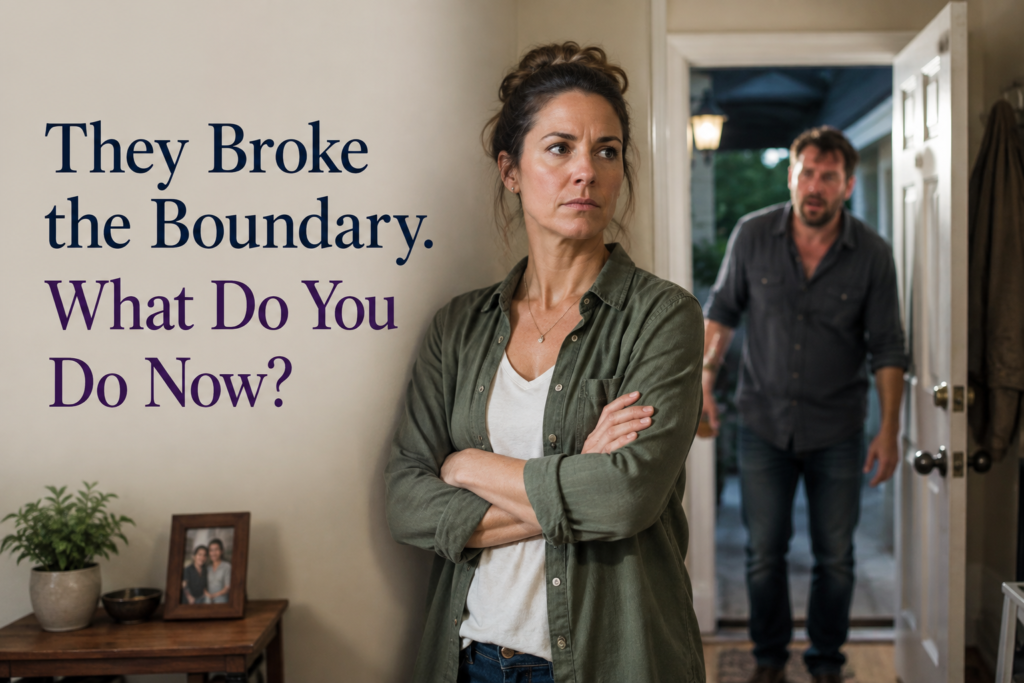
And then they broke the boundary anyway. Now what?
This is the part of setting boundaries that does not get talked about nearly enough. Knowing what your boundary is can be difficult. Saying it out loud can be even harder. But the real test often comes afterwards, when the person you love ignores it, argues with it, pushes against it or carries on exactly as they did before.
You could add:
Broken boundaries in addiction can leave you wondering whether your boundary failed, whether you were too harsh, or what you are supposed to do next.
It may help to understand something important: a boundary has not failed simply because another person did not respect it. Your boundary was never a guarantee about what they would do next. It was a decision about what you would do next.
A Boundary Is Not a Rule They Have to Follow
This is where boundaries can become confusing, particularly when you love someone with an addiction.
You might say, “I have set a boundary that you cannot drink anymore.” But that is not actually a boundary, because you cannot decide whether another adult drinks. It is a rule you would like them to follow.
A boundary brings the focus back to something you can control. You might instead decide, “I will not stay in the same room with you when you are drunk and aggressive.”
They can still drink. They can still become aggressive. They can still tell you that your boundary is ridiculous, unfair or unnecessary. The part that belongs to you is what you do if that happens.
I explored this distinction in Boundaries Are Not Ultimatums: How to Set Healthy Limits When You Love Someone With Addiction. If you are still trying to work out what a healthy boundary actually looks like, I would start there.
But this article begins at the next stage.
You have set the boundary. Now it has been crossed.
The Boundary Has Been Crossed. Pause Before You React.
When someone crosses a boundary, it is very easy to be pulled straight back into the old pattern. You argue. You explain again. You remind them of what they promised. You tell them how much they have hurt you. You threaten a bigger consequence. They become angry, defensive, apologetic or desperate.
Before long, you are discussing everything except the one thing that actually matters: what are you going to do now?
Before responding, pause if you safely can. Ask yourself what you actually said you would do, whether that action is still appropriate, and whether you are genuinely willing and able to follow through.
It can also help to ask whether anything has truly changed, or whether you are simply feeling pressure to make the discomfort go away.
That last question matters. The moment after someone crosses your boundary can be deeply uncomfortable. Their anger, disappointment, panic or distress may immediately activate your urge to fix things.
But discomfort is not always evidence that you are doing something wrong. Sometimes it is simply what it feels like when an old pattern is no longer getting the response it used to get.
Example One: “I Won’t Give You Money While You’re Using”
Imagine you have an adult son who has repeatedly asked you for money while he is actively using drugs. You have paid bills, transferred money, bought groceries, covered rent and rescued him when things have gone wrong. You have done it because you love him and because the thought of him going without frightens you.
Eventually, you decide that you will no longer give him cash while he is using.
Then he calls. He tells you he has no food and needs $100. This is where the boundary becomes real.
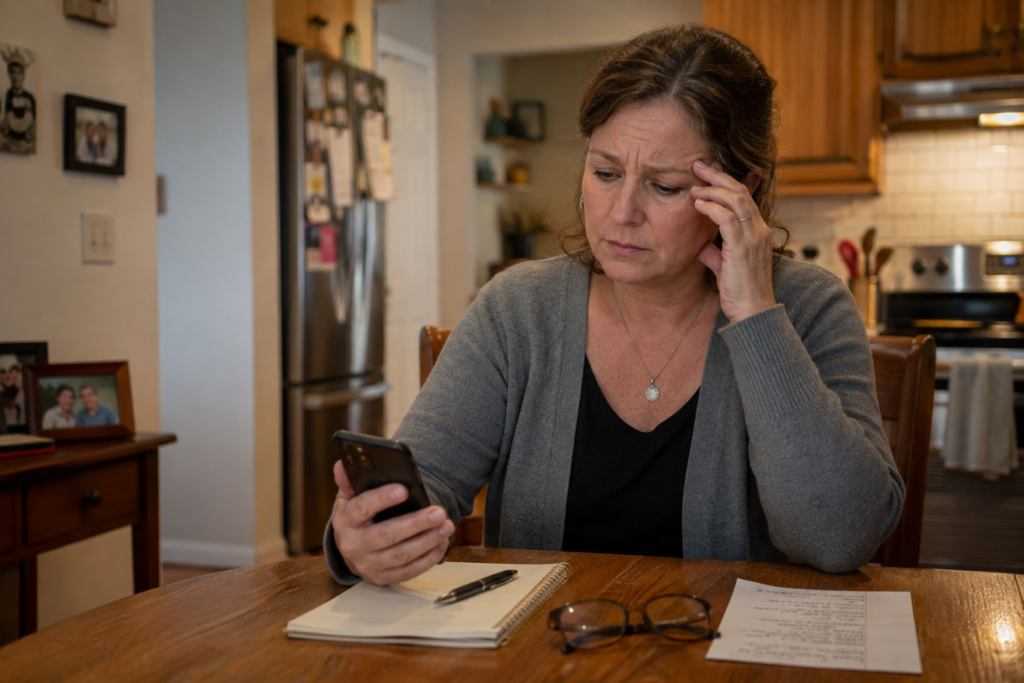
One possibility is that you give him the money.
Perhaps you tell yourself this is different because he says it is for food. You transfer the money. That does not make you weak, stupid or a failure. It gives you information.
Maybe your original boundary was too broad for you to hold. Maybe fear overwhelmed you. Maybe you realised that while you do not want to provide cash, you are still comfortable providing food.
You can reassess. Your revised boundary might become: “I will not give you cash while you are using. If you genuinely need food, I am willing to order groceries directly.”
Now you have a clearer boundary that better reflects what you are actually prepared to do.
Another possibility is that you hold the boundary.
You tell him, “I love you, but I’m not giving you money. I can help you look at other options for food if you want.”
He becomes angry. He tells you that you obviously do not care about him. He says a good mother would not let her son go hungry. He may tell you that if anything happens to him, it will be your fault.
This is the emotional part of boundary work.
Your job is not to convince him that your boundary is reasonable. You can acknowledge his distress without changing your decision.
You might simply say, “I understand that you’re angry. I’m still not giving you money.”
Then you stop debating it.
The boundary does not become stronger because you explain it for another forty minutes. It becomes stronger because your actions and your words eventually match.
This connects closely with the question I explored in Am I Helping — or Making the Addiction Easier to Continue? Sometimes what feels loving in the immediate moment can also protect someone from experiencing the consequences of their own choices.
That does not mean you stop caring. It means you become more thoughtful about what your help is actually helping.
Example Two: “I Won’t Stay in a Conversation Where I’m Being Abused”
Now imagine your partner has been drinking. You have previously told him that you will not stay in conversations where you are being shouted at, called names or insulted.
The conversation begins calmly. Then his voice changes. He starts blaming you. He calls you selfish. He tells you that you have ruined his life.
Your boundary has just been crossed.
One possibility is that you stay and defend yourself.
You tell him that what he is saying is unfair. He argues back. You explain why he is wrong. He brings up something that happened six years ago. You defend that.
Twenty minutes later, you are both discussing things that have almost nothing to do with the original issue, and you are emotionally exhausted.
Again, this is useful information. You have discovered that knowing the boundary intellectually is not the same as being able to hold it while you are being attacked.
You may need a simpler response prepared in advance: “I’m not continuing this conversation while I’m being spoken to like this. I’m going now.”
Then leave the room, end the call or stop responding, depending on the situation and what is safe.
Another possibility is that you end the conversation straight away.
You say, “I’m willing to talk about this when we can speak respectfully. I’m ending this conversation now.”
He tells you that you are avoiding the issue. He follows you. He sends messages. He accuses you of being controlling.
At this point, the temptation is to come back and defend the boundary. But you do not have to win agreement before you are allowed to protect yourself.
You can repeat yourself once if necessary: “I’m not discussing this while I’m being shouted at. We can talk another time.”
Then follow through.

There is an important safety qualification here. If someone is threatening, violent, intimidating, preventing you from leaving or likely to escalate when you attempt to enforce a boundary, this is no longer simply a communication problem.
Your safety matters more than delivering the perfect boundary statement. Seek appropriate professional support and make decisions with safety in mind.
What If They Say Your Boundary Is Controlling?
They might. And occasionally they might even be right. It is worth examining honestly.
A statement like, “You are not allowed to see those friends anymore,” attempts to control another adult.
A statement like, “I will not lend you my car if you have been drinking or using,” controls your own participation.
Those are different things.
A useful test is: Does this boundary tell them what they must do, or does it tell me what I will do?
There will be grey areas, of course. Human relationships have an annoying habit of refusing to fit neatly into diagrams.
But returning to that question can help you see where your responsibility ends and theirs begins.
Family Drug Support Australia also encourages families setting boundaries to consider whether the boundary promotes responsibility, what the risks may be for everyone involved, and whether the response would be acceptable if substance use were not involved.
Those are useful questions because boundaries should not become punishment disguised as self-care.
Do Consequences Mean Punishment?
This word causes a lot of confusion.
A consequence does not have to mean, “You did something wrong, so now I am going to punish you.”
Sometimes the consequence is simply the logical action attached to your boundary.
If you say you will not lend your car when someone has been drinking, the consequence is that they do not get your car. If you say you will end conversations when you are being abused, the consequence is that the conversation ends. If you say you will no longer pay debts created through gambling or substance use, the consequence is that you do not pay the debt.
You are not manufacturing suffering to teach them a lesson. You are removing yourself from something you have decided you will no longer participate in. That distinction matters.
What If You Realise the Boundary Was Unrealistic?
Then change it. There is no prize for stubbornly enforcing a badly designed boundary.
Perhaps you declared in desperation, “If you drink one more time, I’m leaving forever.”
Then they drank again and you discovered you were nowhere near ready to leave. Pretending otherwise will not help you. Instead, get honest.
Why did you make a consequence you were not prepared to carry out? Were you trying to frighten them into stopping? Were you frightened yourself? Did you think a dramatic enough statement would finally make them understand how serious things had become? You can learn from that.
A smaller boundary that you genuinely control is far more powerful than a huge threat you cannot enforce.
You might replace, “If you drink again, I’m leaving you,” with, “I won’t discuss our relationship while you’ve been drinking. If you want to talk about us, we can do that when you are sober.”
That may seem less dramatic. It is also something you can actually do.
What If They Promise It Will Never Happen Again?
This is another difficult moment.
The boundary is crossed. There is an argument. Then comes the apology.
They cry. They tell you they finally understand. They promise they will never drink, use, gamble, lie, disappear or speak to you like that again.
Perhaps they mean every word in that moment. You do not have to decide whether the promise is sincere. You can listen to it without making it responsible for your next decision.
A promise is information. Behaviour over time is information too.
You can say, “I hope that’s true. For now, I’m still going to do what I said I would do.”
That may mean sleeping elsewhere that night. It may mean not giving the money. It may mean taking control of your own bank account. It may mean ending the conversation.
It may mean continuing with plans you have already made rather than cancelling everything because another crisis has erupted.
You do not have to punish them. You also do not have to erase what happened just because they are sorry.
What If Holding the Boundary Makes Things Worse?
Sometimes it will make things more uncomfortable before anything becomes clearer.
If you have regularly rescued, accommodated, covered, explained or backed down, a change in your behaviour changes the relationship dynamic.
The other person may push harder because the old response used to work. That does not automatically prove the new response is wrong. But neither should we romanticise “holding firm” when genuine danger exists.
Ask what the increased conflict is telling you.
Is this ordinary disappointment because you said no? Is it emotional pressure designed to make you reverse your decision? Or is there an actual risk to you, your children, your home, your finances or the person you love? Those situations require different responses.
The goal is not to become rigid. The goal is to become clear.
You Do Not Need Them to Approve of Your Boundary
This may be one of the hardest parts.
You may have spent years trying to get the person you love to understand your point of view. If only I explain it properly. If only they understand how much this is hurting me. If only they realise I am doing this because I love them.
Of course you want to be understood. But their understanding is not a prerequisite for your boundary.
They may think it is unfair. They may disagree with your reasons. They may never see the situation the way you do.
They are allowed their view. And you are still allowed your limit. That is one of the deeper shifts in learning to respond differently to addiction.
As I wrote in Does the Way You Respond to Addiction Matter?, you cannot control another person’s choices, but you do have influence over your own responses and over the patterns in which you participate.
Boundaries are one way we begin putting that principle into practice.
When You Break Your Own Boundary
There is one more person who may break your boundary. You.
You said you were not going to give money, and you did. You said you would end the conversation, and instead you argued for an hour. You said you would stop covering for them, and then you made another excuse on their behalf.
Do not turn that into evidence that you are incapable of changing.
Look at what happened. What were you afraid of? What did they say or do that made the boundary particularly difficult to hold? What were you trying to prevent? What support would have helped you respond differently? Then decide what you want to do next.

Self-coaching is not about judging yourself for getting it wrong. It is about noticing what happened, understanding your response, choosing deliberately, taking action and reflecting on what you learn.
You can begin again.
A Boundary Becomes Real in What You Do Next
Setting the boundary was never the finish line. It was the beginning.
The difficult part is often the moment when someone you love makes a choice you desperately hoped they would not make.
That is when you may discover the uncomfortable truth that your boundary cannot control them. But it can change you.
It can change what you participate in. It can change what you fund. It can change what you tolerate. It can change how long you remain in an argument. It can change whether every crisis automatically becomes your crisis.
It can change the role you play in a pattern that may have been running for years.
And slowly, those choices can help you find your way back to something addiction has a habit of stealing from everyone around it. Your own agency.
Start With One Boundary
If you are struggling to work out what your boundaries should be, do not try to redesign your entire relationship tonight. Choose one repeated situation.
Ask yourself: What is happening that is no longer okay for me?
Then ask: What part of this is actually within my control?
Finally ask: If it happens again, what am I genuinely prepared to do?
Not what might frighten them into changing. Not what you think you are supposed to do. What are you genuinely prepared to do? Start there.
Because a boundary is not something you impose on another person. It is something you decide about your own life. And when they cross it, the question is no longer, “How do I make them respect my boundary?”
The more useful question is, “Knowing what I know now, how do I want to respond?”
That is where your power is.
Need Help Working Out Your Boundaries?
If loving someone with an addiction has left you unsure where helping ends, enabling begins, or what you are allowed to say no to, I have created a free Boundaries Guide to help.
It will help you think through what is happening, what belongs within your control, what your limits may need to be and what following through could look like in real life.
You do not need harsher boundaries. You need boundaries you understand, believe in and can actually hold.
If you are trying to change how you respond to addiction — not by controlling the person you love, but by becoming clearer and steadier in your own choices — this is exactly the work we practise inside the Anchored & Rising Circle.