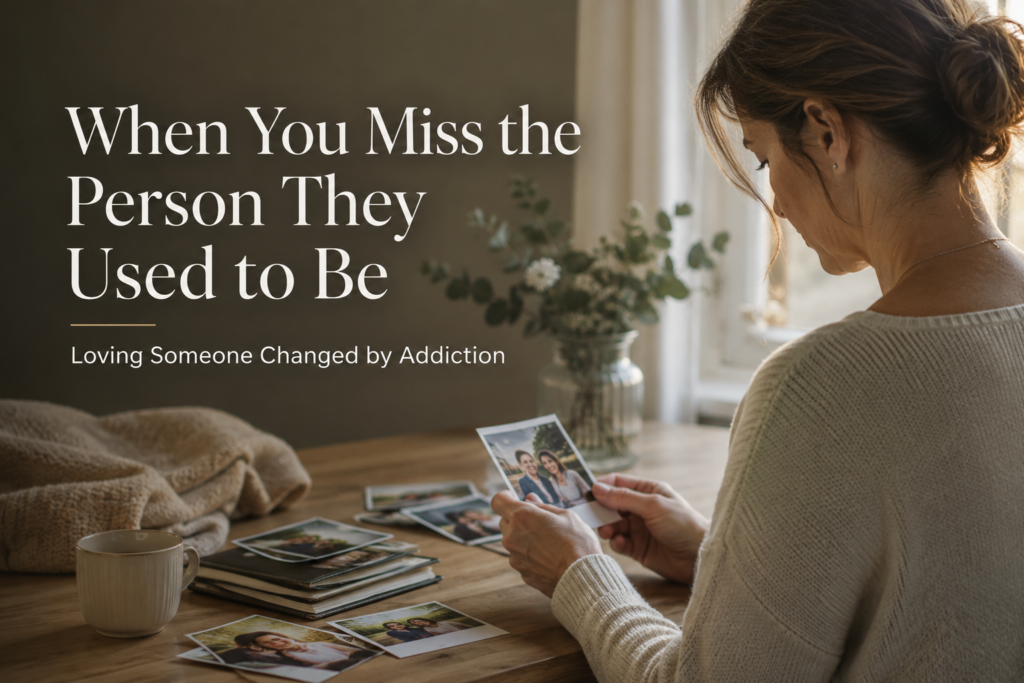
One of the hardest parts of loving someone with an addiction is that you are often not only dealing with who they are now. You are also carrying the memory of and miss the person they used to be.
You remember the version of them who made you laugh — who was kind, present, thoughtful, affectionate, funny, gentle, ambitious, or full of promise. The moments when they seemed so clearly themselves that you thought, “There you are. That’s the real you.”
And that memory is powerful. It can keep you hoping long after your body is exhausted. It can keep you explaining behaviour that hurts you. It can keep you waiting for the person you love to come back from behind the addiction.
That is not because you are naïve. It is because you are loving, and loyal, and because part of you still hopes it may become real again.
When addiction changes someone you love, the grief is confusing because the person is still physically here. You may still see their face, hear their voice, sleep under the same roof, cook for them, worry about them, or manage the fallout of their choices. But emotionally, it can feel as if parts of them have disappeared.
And because they are still here, you may not feel entitled to grieve. You may tell yourself, “It’s not that bad.” You may feel guilty for missing someone who is still alive — or disloyal for admitting that the person in front of you does not feel like the person you once knew.
But this is grief. It may not look like ordinary grief, but it is grief all the same. And you are allowed to name it.
The Good Moments Make It Harder to See Clearly
If someone was cruel all the time, dishonest all the time, chaotic all the time — the situation might be painful, but it would often be clearer. The confusing part is that sometimes they are still loving. Sometimes they are sorry. Sometimes they say exactly what you have been longing to hear.
And then the cycle begins again.
This is why you may find yourself staying after another broken promise, another relapse, another apology, another “this time will be different.” Because you are not only responding to what happened today — you are responding to every good moment that ever convinced you there was something worth saving.
That is attachment. That is history. That is love mixed with hope and fear and memory.
But there comes a point where you have to ask a very honest question:
Am I relating to the person in front of me, or am I organising my life around the person I keep hoping will return?
That question is not cruel. It is not giving up. It is simply asking you to stop abandoning reality in order to protect hope.
Because the truth is this: you can love who someone used to be and still be harmed by who they are now. Someone can have been wonderful at times and still be unsafe for your nervous system. Someone can have loved you deeply and still be unable to treat you with consistency.
The existence of good memories does not erase the impact of current behaviour.

The Terrible Place Many Women Stand
This is where many strong, loving women — and mothers — get stuck. Not because they lack insight. Not because they enjoy chaos. But because their heart is trying to reconcile two realities that do not fit neatly together: the person they remember, and the person they are dealing with today.
If your person is a partner, you may have built your whole life around them — married them, planned a future with them, trusted them. If they are your adult child, the grief runs even deeper. You do not only remember who they were before the addiction became obvious. You remember them as a child — their face when they were little, their laugh, their softness, their innocence. And now you may be facing behaviour that feels impossible to reconcile with the person you raised.
And if they are still under your roof, the stakes can feel unbearable. Because asking them to leave may not feel like a boundary. It may feel like sending them into danger.
That fear makes sense. It does not mean you are overreacting. But it also does not mean your home, your finances, your sleep, your other children, or your sanity have to become the price of keeping them close.
Anyone who tosses out simple advice from the sidelines usually has the luxury of not living inside the consequences. But there is a starting point: tell the truth about what is happening. Not only what might happen to them if you set a boundary, but what is already happening to you if you do not.
If you are dealing with alcohol or drug use in your family and need extra support, organisations such as Family Drug Support Australia can also provide information and support for families.

What This Has Cost You
Without realising it, you may have become the keeper of who they used to be. You remind them of their goodness. You defend their character. You hold the story of their potential. You keep believing in the person underneath the drinking, the using, the lying, the withdrawal, the rage, or the collapse.
There can be something beautiful in that. But it becomes dangerous when you are the only one carrying that memory — because then the relationship quietly becomes built around your belief in who they could be, rather than their responsibility for who they are being.
And somewhere in all of this, you may have lost track of yourself.
The woman who laughed more easily. Who slept through the night. Who trusted her own judgement. Who did not feel constantly on edge or check bottles, bank accounts, moods, and the sound of a car in the driveway. If you are a parent, you may miss being able to simply be their mother, instead of case manager, detective, emergency responder, and security guard all at once.
Addiction does not only change the person using or drinking. It changes the people who love them. It can train you into hypervigilance, over-functioning, rescuing, monitoring, and second-guessing yourself.
So when you grieve, do not only grieve them. Grieve what this has cost you too. Not so you can stay in the grief forever, but so you can stop minimising the impact and stop telling yourself you should be coping better with something that has been quietly wearing you down.
Your pain is not proof that you are failing. It is your inner life saying, “This is costing me too much.”
When You Miss the Person They Used to Be, You Do Not Have to Keep Losing Yourself
You are allowed to miss the person they used to be. You are allowed to miss the relationship you thought you had, the ease, the trust, the laughter, the affection, the version of yourself you were before addiction took up so much space.
But missing them is not the same as being required to keep sacrificing yourself.
You can miss them and still set a boundary.
You can love them and still tell the truth.
You can hope they recover and still stop making your wellbeing dependent on whether they do.
You can care about their pain without handing your whole life over to it.
That is not cold. That is not heartless. That is what it looks like when love grows a spine. And frankly, love needs one. Otherwise it becomes an open cheque book addiction keeps cashing.
A Gentle Practice: Separating Memory From Reality
If this is stirring something in you, take a moment to write two lists.
The first list: “The person I miss.”
Let yourself name what you miss — their humour, their warmth, their presence, their tenderness, their affection, the way things felt before addiction became the third presence in the relationship. If this is your child, let yourself go back through every stage. The little one they were. The teenager you hoped would find their way. The adult you glimpsed before the addiction became so loud.
The second list: “What I am living with now.”
Tell the truth. Write down what is actually happening — the broken promises, the secrecy, the emotional distance, the unpredictability, the financial stress, the fear, the walking on eggshells. If they live with you, include what is happening inside the home: what has changed, who feels unsafe, what behaviour is being tolerated because you are afraid of what happens if you do not.
Then look at both lists side by side.
This is the grief. This is the gap you have been trying to close with more patience, more understanding, more forgiving, more hoping, and more of yourself.
You do not have to make a dramatic decision today. But you can begin by telling yourself the truth about the difference between who you miss and what you are living with. That truth may hurt. But it can also let you put down something you were never meant to carry alone.

You Do Not Have to Stop Loving Them to Start Coming Back to Yourself
Many women believe they have only two choices: keep loving and keep disappearing, or stop loving and become hard.
There is another way.
You can love them and begin returning to yourself. You can hope for their recovery and still build your own. You can miss who they used to be and still protect the woman you are becoming. And if this is your adult child, you can remain their mother without letting addiction make every decision in your home.
That may be the most honest kind of love there is. Not the frantic love that begs, rescues, and burns itself out trying to force a miracle. The steadier kind that says, “I care about you, but I cannot keep abandoning myself to prove it.”
Your grief makes sense. Your loyalty makes sense. Your love makes sense. You stayed because someone mattered to you.
And you matter too. Not later. Not after they get better. Now.
Start With One Steady Step
If loving someone with addiction has left you exhausted, confused, and unsure what is yours to carry, you do not have to figure it all out at once.
A good first step is to take the Find Your Next Steady Step quiz. It will help you recognise the pattern you may be caught in right now and guide you toward the support that best fits where you are.
From there, you can begin The List, my free training for women who love someone with an addiction and want to understand what can actually help — for you, for them, and for the relationship.