

There is a particular kind of grief that does not come with a funeral, a casserole from the neighbours, or anyone asking how you are holding up.
It does not arrive in a single moment. Nobody sits you down and says, “I’m sorry for your loss.” Because from the outside, there is no loss. The person you love is still here. Still breathing. Still in the house, or still answering your messages, or still showing up — sort of — to the things that matter.
And yet something in you knows that something is gone.
You may not have named it. You may not have let yourself name it. Because naming it feels too close to giving up on them. And you are not ready to do that.
But here is what is true: grief does not wait for permission. And it does not only come for the dead.
What Is Ambiguous Loss?
Ambiguous loss is a term used in psychology to describe a loss that has no clear ending, no social recognition, and no tidy resolution. It was first described by a researcher named Pauline Boss, and if you have never come across this term before, I want you to sit with it for a moment — because it may be the most accurate description of what you have been living with.
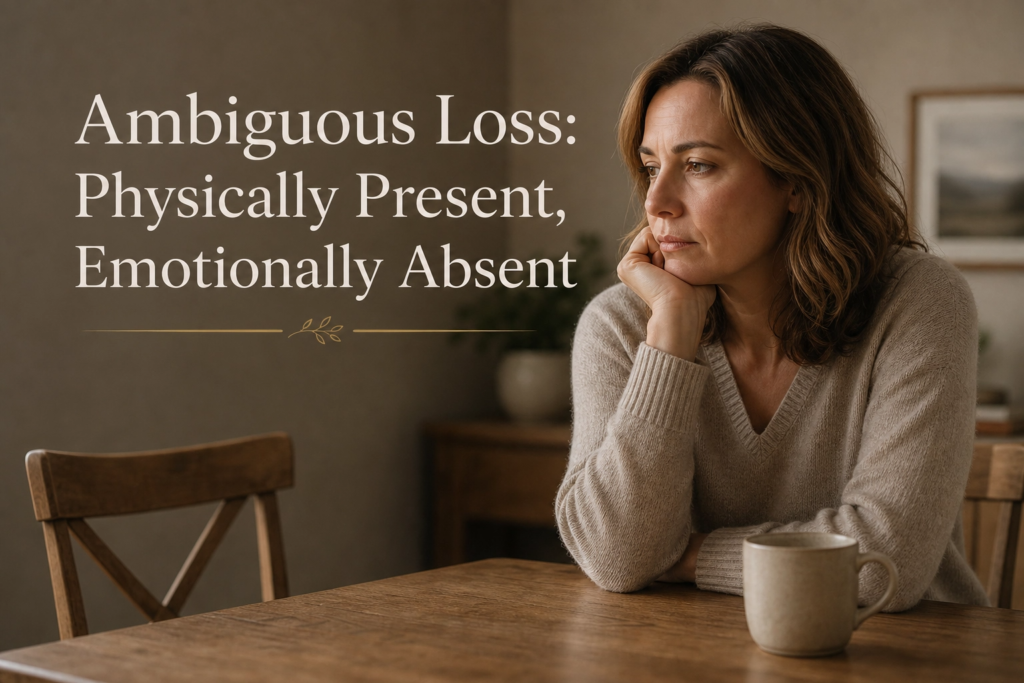
In everyday language, ambiguous loss is what happens when someone is physically present but emotionally or psychologically absent. Or when someone is emotionally present in your heart but physically gone from your life. When addiction is involved, it is usually the first kind.
The person you love is right there. You can see them, hear them, sometimes touch them. But the version of them you fell in love with — the one you built a life with, or built hopes around — can feel very far away. They may be consumed by the addiction, or by shame, or by denial, or by survival. They may show up in glimpses, and those glimpses are both a relief and a fresh source of pain. Because the glimpses remind you of exactly what you are missing.
That is not an ordinary kind of grief. And it is not made easier by the fact that they are still technically here.
Loving Someone Who Is Still Here
Here is what makes ambiguous loss so relentless: there is no clear moment at which you are allowed to grieve.
When someone dies, there is a before and an after. There is a date on a calendar. There are rituals. People around you understand that something has ended, and they respond accordingly.
But when someone is alive and still in your life, and still the person you love, there is no permission structure for your grief. There is no recognised language for it. You cannot say “I am grieving my partner” when your partner is sitting in the next room. You cannot tell people you have lost someone when that someone still calls you on your birthday.
I’ve talked about this more in the post, How Addiction Changes the Person You Love.
So the grief goes underground.
It shows up as a hollow feeling you cannot quite explain. It shows up as sudden sadness in the middle of an ordinary Tuesday. It shows up when you see other couples laughing together and feel something twist in your chest. It shows up when the phone rings and you brace yourself before answering. It shows up in the way you have slowly stopped making plans too far in advance, because experience has taught you not to count on things holding together.
It shows up as exhaustion that is not about sleep.
What can you do with this? Start by naming it — to yourself, even if to no one else. What you are feeling is not weakness. It is not ingratitude. It is not a sign that you do not love them enough, or love them too much, or are handling this wrong. It is grief. Real grief. For a person who is still here, and for a relationship that has been changed by something neither of you fully chose.
Naming it does not mean giving up. It means being honest about what this has cost you.
Mourning the Life You Thought You’d Have

Alongside the grief for who they are now, there is often a quieter, more private grief.
The grief for the life you thought you were going to have.
This one can be hard to admit, because it can feel selfish. You may think: they are the one struggling. Who am I to grieve the holiday we did not take, the retirement we did not plan, the version of our family I imagined?
But this grief is real, and it deserves a place.
You may be mourning the future that felt certain, and no longer does. The plans that kept getting cancelled or postponed. The version of yourself you were becoming before so much of your energy went into managing this. The easy Saturday mornings. The trust you used to have. The ability to relax inside your own home.
You may be mourning the relationship you thought you were in — not because it was all perfect, but because it was not this. It was not the constant calculation. It was not the performance of normalcy. It was not the exhaustion of loving someone who is present in body and somewhere else in everything that matters.
None of this means you have made a mistake. None of it means you should leave, or stay, or fix anything right now. Grief is not an instruction. It is not telling you what to do. It is simply the evidence of how much something has mattered to you.
And your loss matters.
Why You Have Not Named It Until Now
There are a few reasons this kind of grief goes unnamed, and they are worth understanding — because understanding them can help you stop turning the pain back on yourself.
You have been too busy holding everything together. Grief requires a kind of stillness, and you have not had stillness. You have been managing, monitoring, fixing, hoping, and bracing. There has not been a quiet enough moment for the grief to surface fully.
You are afraid that naming it makes it permanent. If you grieve the relationship, does that mean the relationship is over? If you mourn the life you thought you’d have, does that mean you have given up on any version of it? Not necessarily. Grief is not the same as surrender. You can grieve something and still love it. You can mourn a loss and still hope things change.
No one has told you that you were allowed to. This is probably the biggest one. The people around you may be focused on the person with the addiction — their struggle, their recovery, their needs. You may have been told, directly or indirectly, that your role is to support, not to suffer. That your job is to be strong. That your pain is secondary, or a distraction from the real problem.
But your pain is not secondary. And carrying grief you have never named is one of the heaviest things a person can do.
What Naming It Actually Does
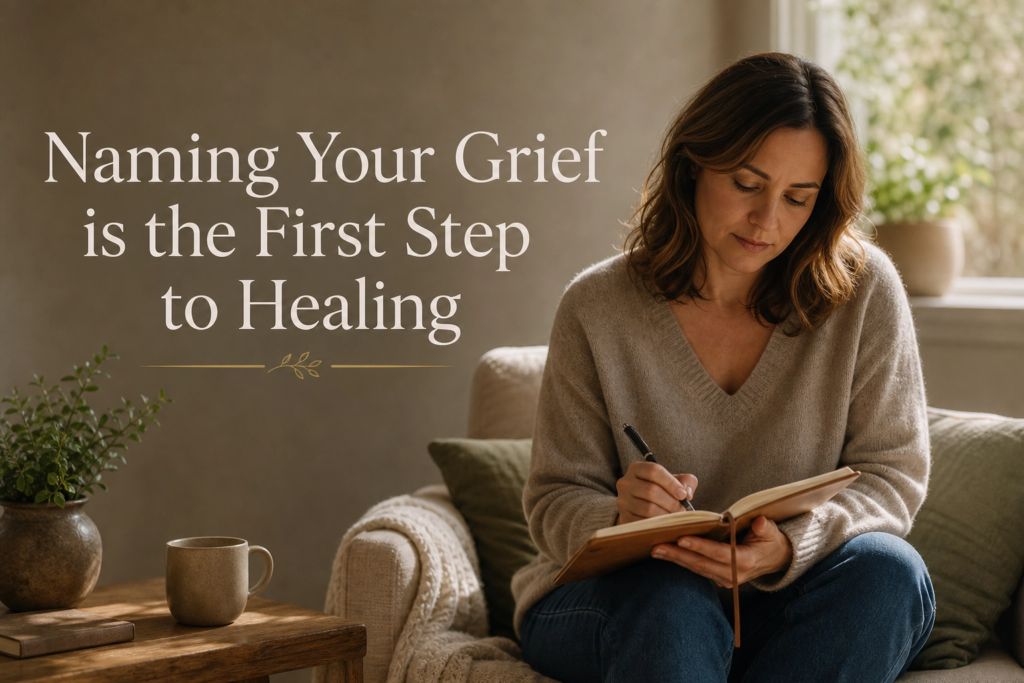
Naming grief does not make it worse. In most cases, it does the opposite.
When grief has a name, it stops being a vague, shapeless weight that follows you around. It becomes something you can actually look at. Something you can say: this is what I am carrying, and here is why, and it makes sense that it is heavy.
That clarity does not fix everything. It does not change what the person you love is doing, or not doing. But it changes your relationship to your own pain — and that matters enormously.
When you can say “I am grieving the life I thought I would have,” you stop having to pretend that everything is fine when it is not. You stop having to perform steadiness you do not feel. You start being honest with yourself about the cost of this — and from that honesty, you can start to think about what you actually need.
Not what they need. What you need.
That is not a small thing. That is, in fact, where a lot of healing begins.
A Practical Place to Start
If any of this has landed for you, here is something concrete you can do.
Set aside ten minutes — not to fix anything, just to notice. Take a piece of paper or open the notes on your phone, and complete these sentences:
- The version of them I am grieving is…
- The life I thought we would have included…
- The part of myself I miss most is…
- The thing I have not been allowed to say out loud is…
You do not have to share this with anyone. You do not have to do anything with it. But getting it out of your head and onto a page is a way of saying: this is real, and it matters, and I see it.
That is the beginning of taking your own experience seriously.
You Do Not Have to Carry This Alone
If this resonated with you, there are two places you might want to go next.
The List is my free training for women who love someone with an addiction. It is practical and direct — designed to help you get clear on what you have been doing, what has not been working, and what might actually help. You can access it at whywonttheystop.com.
Find Your Next Steady Step is a short free quiz that helps you identify the pattern you are most caught in right now — whether that is suffering in silence, carrying too much, trying to build boundaries, or beginning to come back to yourself. It takes a few minutes, and your result comes with a free resource matched to where you are. You can take it at whywonttheystop.com/take-the-quiz/
Because the grief you have been carrying deserves more than silence.
And so do you.