There is a particular kind of grief that comes with loving someone with an addiction, especially when you begin to wonder: what if they never recover from addiction?
It is not only grief for what has happened, but grief for what you believed all your love, patience, support and sacrifice might eventually lead to.
You may have spent years believing that one day they would get better. One day they would understand. One day the chaos would settle and you would both be able to look back at everything you had survived and know that, somehow, it had been worth it.
Then a frightening thought begins to creep in: What if they never recover? What if they never stop drinking or using? What if they keep returning to the same destructive patterns? What if the relationship never becomes what you hoped it would be, or the person you love never reaches the life you have spent years trying to help them reach?
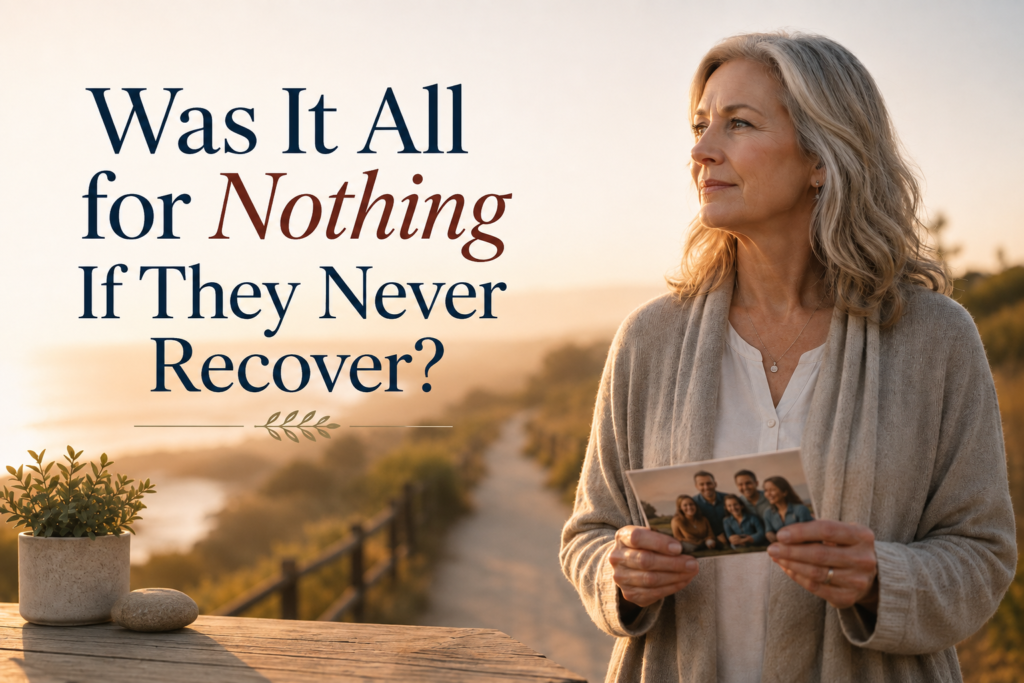
And behind that question sits another one: Was it all for nothing?
When Their Recovery Becomes the Ending You Are Waiting For
When someone you love is caught in addiction, it is easy for their recovery to become the ending you are waiting for. You endure because things might change. You forgive because perhaps this time will be different. You help because maybe this will be the thing that finally turns everything around.
You remember who they were before addiction became so dominant, or you see glimpses of the person who is still there underneath it. Hope keeps you going, sometimes for years.
That longing can be powerful, especially when part of you is still attached to the person they were — or the future you once imagined together. If that feels familiar, you may also find Why Do I Still Want Them Back After Everything That Happened? helpful.
There is nothing foolish about hope. There is nothing foolish about loving someone or wanting them to recover. But there can come a point where your own peace becomes dependent on an outcome you cannot control.
Without realising it, you may begin postponing your life until they get better. When they recover, I can relax. When they recover, our family can heal. When they recover, I will know that everything I did mattered.
But their recovery cannot be the thing that decides whether your life has meaning. Their recovery belongs to them. Your life still belongs to you.
You Cannot Measure Your Love by What It Produced
This can be one of the hardest things to accept: you can love someone deeply and they may still continue using. You can support recovery and they may still relapse. You can communicate carefully and they may still lie. You can set boundaries and they may still be angry about them.
You can stop rescuing, stop covering up consequences, stop giving money, stop trying to manage everything — and they still may not change.
That does not mean you failed.
It means another person’s recovery was never something you could manufacture through enough love, effort, vigilance or sacrifice.
This is where many people get trapped. They look back at everything they did and judge its value by the eventual outcome. If the person recovers, perhaps the years of effort feel justified. If they do not, it can feel as though all that effort was wasted.
But love is not an investment contract. There was never a guaranteed return.
Some of the things you did may have helped. Some may have protected them from consequences they needed to experience. Some choices you would probably make differently now. That is part of looking back honestly.
That distinction is not always easy to see when you are in the middle of it, which is why it can help to look more closely at whether your support is helping — or making the addiction easier to continue.
But you made those decisions with what you knew, what you believed and what you could cope with at the time. You do not have to rewrite your entire history as a mistake simply because you know more now.

The Years Were Still Your Life
There is another uncomfortable truth here. Those years were not a waiting room. They were your life.
Perhaps addiction consumed more of them than you wish it had. Perhaps you spent far too much time worrying, checking, rescuing, arguing, researching, hoping, recovering from crises and trying to prevent the next one.
You may have missed things. You may have put your own needs aside. You may look back and wish you had drawn a line sooner. That deserves grief.
But there is a difference between grieving what addiction cost you and deciding that those years had no value.
You were still living. You were learning. You were loving. You were making decisions under difficult circumstances. You were becoming someone, even if you could not see it at the time.
You may have learned where your limits are. You may have learned that love and responsibility are not the same thing. You may have learned that helping can slide into rescuing, that boundaries without follow-through are only requests, or that you can survive things you once believed would break you.
If boundaries have been part of your struggle, you may also want to read They Broke the Boundary. What Do You Do Now?, which looks at what happens after a limit has been crossed.
Those lessons do not make the pain worthwhile. Pain does not need to be justified by a lesson. But neither does pain erase everything that came from living through it.
The Fear of Letting Go of What You Have Already Invested
Sometimes we keep going because stopping feels like admitting that everything we have already given was wasted.
You may think, I have stayed this long. I have done so much. I cannot give up now.
That thought can keep people in painful situations for years.
But what you have already given does not create an obligation to keep giving.
The years behind you are gone whether you continue exactly as you are or decide to change direction. The better question is not, How much have I already put into this?
It is: Knowing what I know now, what do I want to do next?
That question is much harder because it brings you back into the present. It asks you to look at what is actually happening rather than what you have hoped might eventually happen.
It also gives you some power back.
Hope Does Not Have to Mean Waiting
You do not have to stop hoping that someone you love will recover.
But hope can change shape.
You can hope they recover without making your wellbeing dependent on it. You can hope they seek help without organising your life around whether they do. You can hope they find their way while accepting that you cannot walk that road for them.
Learning to separate what belongs to you from what belongs to them can make this much clearer. I explore this idea further in my video, What Is Mine and What Is Not Mine?
That is not giving up on them.
It is giving up the belief that your life must remain on hold until theirs changes.
Sometimes the healthiest form of hope sounds less like, I know they will recover, and more like, I hope they recover, and I will take care of my own life either way.
There is a great deal of freedom in that distinction.

What If They Never Recover From Addiction?
This is the question people often do not want to ask because it feels too final. But asking it does not make the outcome happen. It simply allows you to consider what your life needs if their addiction continues.
If they never recover, what do you need to protect?
What relationships do you want to preserve?
What parts of yourself have been pushed aside?
What financial, emotional or practical limits do you need?
What would it mean to build a life that contains love for them without being consumed by their addiction?
You do not need to answer all of those questions today. But you are allowed to ask them.

It Was Not All for Nothing
If someone you love never recovers, it does not mean your love was meaningless. It does not mean every effort you made was foolish, or every hopeful moment was a mistake.
It means you loved a person who was struggling with something you could not control.
Perhaps you stayed longer than you now wish you had. Perhaps you tried too hard to fix things that were never yours to fix. Perhaps there are choices you regret.
That is very different from saying your life was wasted.
You are allowed to take what you have learned and use it now. You are allowed to change how you respond. You are allowed to stop measuring your life against somebody else’s recovery.
And you are allowed to move forward without knowing how their story ends. Their recovery may still happen. It may not. But your life does not have to wait for the answer.
You Don’t Have to Work Out What Comes Next Alone
If you are beginning to ask what your life might look like — whether they recover or not — this can be difficult territory to navigate on your own.
I offer one-to-one coaching for women who love someone with an addiction and want a calm, practical space to work through what is happening, what is theirs to carry, and what they want to do next.