I nearly didn’t make the video this post is based on. I was tired, running on about four hours’ sleep, and questioning whether I had anything useful to say. But then I thought that maybe it didn’t need to be polished. Maybe it just needed to be honest.
I got it done. It’s not pretty but it is honest. If you’d rather watch or listen, you can find it here:
So here’s the raw message: if someone you love has an addiction, their addiction can slowly become the centre of your whole life. Their drinking, using, moods, promises, relapses, recovery, and consequences can start to take up more and more space in your mind, your body, your home, your sleep, your decisions, and your sense of self. Somewhere along the way, without even noticing it at first, you can start to disappear.
When Their Addiction Starts Taking Over Your Life
This often happens because you have loved hard, hoped hard, and given so much of yourself trying to help. Love, fear, loyalty, guilt, hope, and exhaustion can become tangled together until it becomes difficult to see where their life ends and yours begins.
You keep trying to help. You keep trying to prevent the next disaster. You keep trying to say the right thing, set the right boundary, offer the right support, or finally get them to see what their addiction is doing. But while so much of your energy is going toward their choices, your own life can quietly get smaller.
You may stop making plans because everything feels uncertain. You may stop seeing friends because you are too tired to explain. You may stop sleeping properly because your body is always waiting for the next crisis. You may stop asking yourself what you need because their needs, moods, risks, and consequences seem to fill every available space.
And then one day, you realise their addiction has not only affected their life. It has started shaping yours.
If You’re Married to Someone With an Addiction
If you are married to someone with an addiction, I’m not going to tell you to leave. That is not my call to make for you.
Real life is too personal and too complicated for a stranger on the internet to decide. There may be children, money, housing, history, love, fear, promises, good days, bad days, and a thousand practical realities that make the decision far more complex than people on the outside often understand.
But I will say this: build your own life anyway.
Whether you stay or go, you need something that belongs to you. You need your own interests, friendships, routines, support, health, goals, and future. If your whole life depends on whether they drink or use today, you are living on emotional quicksand.
You may love them deeply. You may want the relationship to work. You may still see the good in them. And you still need a life that does not orbit entirely around their addiction.
That is not about loving them less. It is about remembering that your life matters too.
If You’re the Mother of Someone With an Addiction
If you are the mother of someone with an addiction, the situation has a different kind of pain. You do not leave your child in the same way you might leave a partner. You do not stop being their mother. You do not stop loving them or hoping they find recovery.
That bond can be deep, fierce, loyal, and full of memory. You remember who they were before the addiction took hold. You may still catch glimpses of that person and keep hoping they will come back to themselves.
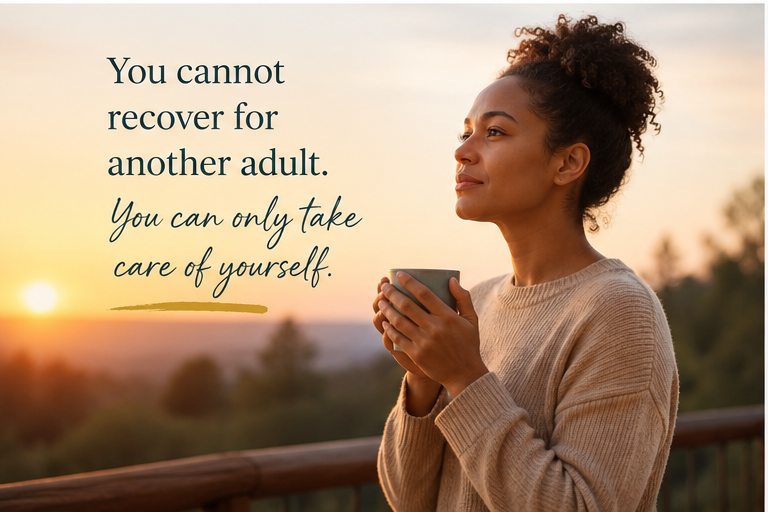
But even here, the hard truth remains: you cannot recover for them.
If you often feel responsible for whether they recover, this related post may help: When You Feel Responsible for Their Recovery.
You cannot make their choices for them. You cannot control their consequences. You cannot love them hard enough to make them stop. If love, effort, worry, and sacrifice were enough to save someone from addiction, many people would already be well.
There is a difference between caring deeply and rescuing at the cost of yourself. I talk more about that here: Care vs Rescue: How to Love Someone Without Losing Yourself.
At some point, loving them may need to include letting them own what is theirs, including their choices, their recovery, their consequences, and their next step.
That does not mean you stop caring. It means you stop living as though your constant worry, rescuing, monitoring, explaining, or sacrificing can control the outcome.
You can love them and still build your own life. Not instead of loving them, but alongside it.
The Question No One Wants to Ask
Here is the question I want you to sit with:
If their addiction is your whole life right now, what happens if they die, leave, get better, or keep repeating the same patterns for another five, ten, or twenty years?
What will be left of you?
That question may feel uncomfortable, but it matters. If your whole identity has become watching, worrying, rescuing, managing, anticipating, fixing, protecting, and hoping, then their addiction has taken more than their peace. It has taken yours too.
If you’re unsure where support ends and rescuing begins, you may also find this post helpful: Am I Helping or Enabling Someone With Addiction?
This is not about blame. It is about noticing the cost.
It is about recognising where your own friendships, sleep, confidence, interests, health, joy, work, plans, and sense of self may have been pushed aside while you tried to survive someone else’s chaos.
Loving Them Does Not Mean Losing Yourself
Building your own life does not mean you do not love them. It does not mean you are giving up. It does not mean you are cold or uncaring.
It means you are remembering that you exist too.
You can love someone and still go for a walk. You can love someone and still see a friend. You can love someone and still return to something you used to enjoy. You can love someone and still sleep, say no, or let a consequence belong to them.
If saying no feels harsh or frightening, this may help too: Boundaries Are Not Ultimatums: How to Set Healthy Limits When You Love Someone With Addiction.
You can love someone and still build something that does not collapse every time they make another choice you cannot control.
That is not abandonment. It is self-preservation. And sometimes, it is the beginning of healthier love.
The List I Went Looking For
When I was lost in my loved one’s addiction, I went looking for help. There was a lot of help available for my loved one, if they were ready to get well. But there was very little for the exhausted, confused family standing beside them.
I found a family support group that had been around for a very long time, and I drove two towns over to attend meetings in a church hall.
I went full of hope because I was desperately looking for the list — the list of things I could do to make my loved one stop.
I wanted someone to tell me what to say, what not to say, what to do, how to make them understand, and how to get them to choose recovery.
Instead, what I heard was that I was part of the problem and that I needed to do the recovery program myself. I have to admit, I was furious and devastated. The kind of hope I was desperately looking for was not there.
Years later, after living with this with more than one loved one, I understand something I did not want to understand back then.
The list I was looking for — the one that makes them stop — does not exist.
There is no perfect sentence, perfect boundary, perfect explanation, perfect crisis, or perfect amount of love that can make another adult choose recovery before they are ready or willing.
What Can Start to Help
The fact that you cannot make them stop does not mean there is nothing you can do.
What can start to help is learning what belongs to you and what does not. It can help to notice where you are disappearing, understand the difference between support and rescuing, and begin building your own life again in small, practical ways.
This is not about transforming everything overnight. It might start with one walk, one phone call, one decent meal, one boundary, one journal page, one appointment, or one decision not to chase, fix, explain, or rescue today.
It might start with asking yourself, “What have I stopped doing because of their addiction?” Or, “What is one small thing I can do today that belongs to me?”
You do not have to rebuild your whole life in one dramatic leap. You can begin with one small act of return.
Their Addiction Cannot Be Your Whole Life
The message is simple: love them if you love them. Support them if that is right for you. Hope for them if hope is still there. But do not disappear into their addiction.
One way or another, things change. They may recover. They may leave. They may die. They may keep cycling through the same chaos for years.
Whatever happens, you need to still be there. Your life matters too. Your peace, health, future, friendships, interests, and sense of self matter too.
You do not have to carry this alone, and you do not have to disappear to prove that you love them.
Reclaiming your life does not mean that you stop caring about whether your loved one recovers. It means recognising that their addiction cannot remain the organising centre of every decision you make. What Can I Do to Make My Loved One Stop Drinking or Using Drugs? offers practical guidance on what you can influence while protecting your own wellbeing and future.
Ready for More Structured Support?
If you are ready for more structured support, I’d love to invite you into Anchored & Rising Circle. This is a supportive membership for women who love someone with an addiction and want help coming back to themselves without being told what to do about the relationship.
Inside, we focus on steadiness, boundaries, self-trust, emotional clarity, and rebuilding your own life alongside the reality of loving someone whose choices you cannot control. It is not crisis support, counselling, or addiction treatment, but it is a place to learn, reflect, practise, and be reminded that you do not have to carry this alone.
Click here to join the Anchored & Rising Circle.
Free Training: The List
I created a free training called The List for women who love someone with an addiction and feel exhausted, confused, responsible, or lost in the chaos.
It is not the list that makes them stop, because that list does not exist. But it can help you begin to understand what is yours to carry, what is not yours to control, and how to start coming back to yourself.
You can access the free training here:
https://whywonttheystop.com/the-list/
Or visit:
whywonttheystop.com
You do not have to carry this alone.