When you love someone with addiction, the emotional load can become enormous. You may also hear this called emotional labour or mental load — the invisible work of managing feelings, moods, relationships, expectations, and tension. And when addiction is involved, that work can become relentless. And, carrying it is exhausting.
The exhaustion is not only about the obvious things. It is not only the late nights, the broken promises, the arguments, the money stress, the secrecy, the relapses, or the practical mess left behind.
A lot of the exhaustion comes from the invisible work.
The work of reading the room before anyone else does. The work of noticing a change in tone, a shift in energy, a look in their eyes, the way they answer a question, the silence after a message, the way they are walking through the door. The work of deciding whether to speak, whether to stay quiet, whether to ask, whether to wait, whether to intervene, whether to pretend you have not noticed what you have definitely noticed.
This is emotional load or labour. It is also sometimes called mental load. This may already be present in some relationships. And, when addiction is present in someone you love, that emotional labour can become relentless.
You may be the one trying to keep everyone calm. You may be the one smoothing things over with the children, the family, the workplace, the neighbours, or the wider world. You may be the one making excuses, softening the truth, managing the mood in the house, preparing for the next disappointment, and trying to stop everything from falling apart.
I’ve also written about this in a former post: Why Loving Someone With Addiction Is So Exhausting (And Why It’s Not Your Fault)
And because so much of this work happens inside you, other people may not see it.
They may see you functioning. They may see you going to work, answering messages, making dinner, remembering appointments, paying bills, smiling when required, and getting on with things. What they may not see is the constant calculation happening underneath.
They may not see the amount of energy it takes just to keep yourself steady.

What emotional labour looks like when addiction is involved
Emotional load or labour is often described as the work of managing feelings, relationships, expectations, and emotional responsibilities. In families affected by addiction, it can become much more intense because the emotional environment is so unpredictable.
You may be constantly trying to work out what is really going on. Are they sober? Are they lying? Are they using again? Are they ashamed? Are they angry? Are they about to disappear? Are they about to ask for money? Are they going to make a promise you already know they may not keep?
You may be managing your own emotions while also trying to manage theirs. You may be scared, furious, hurt, disappointed, and exhausted, but still trying to speak gently because you do not want to make things worse. You may be swallowing your own distress because they are already fragile, defensive, ashamed, or volatile. You may be trying to choose words carefully so they do not shut down, lash out, leave, relapse, or turn the conversation back on you.
That is a huge load to carry.
You may also be managing the emotions of everyone else around the situation. Children may need reassurance. Parents may need updates. Friends may ask awkward questions. Other family members may have opinions, blame, advice, judgement, or denial. You may find yourself translating the situation for everyone else while privately feeling like you do not even understand it yourself.
This is one of the cruel parts of loving someone with addiction. You can become the emotional container for a situation you did not create and cannot control.
Why it becomes so exhausting
Emotional labour becomes especially draining when it is ongoing, one-sided, and unacknowledged. In a healthy relationship or family system, emotional care moves both ways. People notice each other. They repair. They take responsibility. They check in. They apologise and adjust. Not perfectly, of course, because humans are not exactly precision instruments. But there is some kind of balance.
When addiction is active, that balance often disappears.
The person with the addiction may be consumed by craving, shame, secrecy, denial, defensiveness, withdrawal, or survival. They may not have the emotional capacity to notice what you are carrying. They may be so focused on avoiding their own pain that they cannot properly see yours.
This does not mean they do not love you. It also does not mean their behaviour is acceptable. Both things can be true. Addiction can change how someone shows up, and you can still be deeply affected by the way they are showing up.
Over time, you may start doing more and more of the emotional work for both of you. You anticipate problems. You monitor risk. You soften consequences. You protect their image. You try to prevent conflict. You try to reduce their shame. You try to keep hope alive. You try to hold onto the version of them you know exists underneath the addiction.
And somewhere in all of that, you may lose track of what you are feeling.
You may become so focused on keeping the emotional temperature around them stable that you stop asking whether you are okay. You may become very good at detecting their mood and very poor at noticing your own needs. You may know exactly when they are “off”, but have no idea when you last felt peaceful.
That is not a character flaw. It is what can happen when your nervous system has been trained by repeated stress to prioritise threat detection over self-connection.
The invisible questions you keep carrying
A lot of emotional labour is made up of questions no one else hears.
Should I say something? Should I leave it? Is this the addiction talking? Am I being too harsh? Am I being too soft? If I set this boundary, will it push them further away? If I do not set it, am I enabling them? What do I tell the kids? What do I tell my family? What if this time is different? What if it is not? What if I am abandoning them? What if I am abandoning myself?
These questions can become a constant background noise. Even when nothing dramatic is happening, you may still feel tense because you are waiting for the next thing. You are not only dealing with the present moment. You are also carrying the memory of what has happened before and the fear of what may happen next.
That is why people around you may not understand why you are so tired. From the outside, it may look like “nothing happened today”. But inside you, a hundred assessments may have happened before breakfast.
You may have noticed their mood. Checked your phone. Wondered whether money had gone missing. Thought about whether to ask a question. Decided not to. Rehearsed a conversation in your head. Imagined three possible outcomes. Tried to act normal. Felt guilty for feeling resentful. Told yourself to be compassionate. Then felt angry that compassion keeps being expected of you when you are running on fumes.
That is not nothing.
That is labour.
Why you may feel responsible for everyone’s emotions
Many women who love someone with addiction find themselves feeling responsible for the emotional state of the whole household. This can happen gradually. At first, you may simply be trying to help. You may step in because things are difficult, because someone has to, because you love them, because there are children involved, because bills need paying, because the truth feels too heavy, or because crisis demands action.
But over time, helping can quietly turn into holding everything.
You may start to believe it is your job to keep them calm, hopeful, safe, motivated, connected, and functional. You may feel responsible for preventing their shame from getting worse. You may feel responsible for making sure they do not feel judged. You may feel responsible for keeping the family together. You may feel responsible for making the situation look less frightening than it is.
And if something goes wrong, you may turn on yourself.
Maybe I said it the wrong way. Maybe I pushed too hard. Maybe I should have been kinder. Maybe I should have seen it coming. Maybe I should have done more.
This is where emotional labour becomes dangerous to your sense of self. Not because caring is wrong, but because carrying responsibility for another adult’s addiction, emotions, choices, recovery, relapse, honesty, and wellbeing is too much for one person. It is too much because it was never all yours to carry.
You can care deeply without being responsible for everything.
You can love someone without becoming the emotional shock absorber for their addiction.
The grief underneath the labour
Underneath emotional labour, there is often grief.
Grief that the relationship does not feel equal. Grief that you cannot relax. Grief that you have to think about things other people may never have to consider. Grief that love has become tangled with fear, vigilance, disappointment, and strategy. Grief that you miss the person they used to be, or the person you still see in glimpses.
There may also be grief for yourself.
You may miss who you were before so much of your energy went into managing the situation. You may miss feeling light. You may miss being spontaneous. You may miss trusting your own judgement. You may miss having normal worries instead of addiction-shaped ones. You may miss being able to make a cup of tea without mentally preparing for another emotional ambush.
This grief deserves tenderness. It does not mean you are selfish. It does not mean you have stopped loving them. It means something has cost you something.
And naming that matters.
Because when you do not name the emotional labour, you may assume you are just weak, negative, impatient, anxious, controlling, or not coping well enough. But when you can see the size of what you have been carrying, your exhaustion starts to make sense.
Emotional labour is not the same as love
This part can be hard to admit, but it is important.
Sometimes emotional labour can start to feel like proof of love. If I love them, I will keep trying. If I love them, I will understand. If I love them, I will be patient. If I love them, I will absorb the impact. If I love them, I will not make things harder for them.
But love should not require you to disappear.
Love may involve care, patience, forgiveness, and effort. Of course it does. Any meaningful relationship will ask something of us. But love is not the same as constant emotional management. Love is not the same as abandoning your own needs to protect someone from discomfort. Love is not the same as carrying the consequences of choices you did not make.
When addiction is involved, this distinction can become blurry. You may believe that stepping back from emotional labour means you are being cold or cruel. But sometimes stepping back is not a lack of love. Sometimes it is the beginning of sanity.
It may sound like: I can care about your feelings without organising my entire life around preventing them. I can listen without taking responsibility for fixing this. I can be compassionate without lying to myself. I can love you and still tell the truth.
That is not cruelty. That is clarity.
What begins to change when you stop carrying it all
Healing from this kind of exhaustion does not usually begin with one dramatic decision. It often begins with noticing.
You begin to notice when you are doing emotional work that no one asked for, no one sees, and no one is sharing. You begin to notice when you are rehearsing conversations in your head for hours. You begin to notice when you are adjusting your tone to manage someone else’s reaction. You begin to notice when you are making excuses, smoothing things over, or carrying anxiety that does not belong entirely to you.
Then, gently and imperfectly, you begin to put some of it down.
You may stop explaining things to people who are committed to misunderstanding. You may stop protecting someone from every consequence. You may stop checking and rechecking. You may stop trying to find the perfect sentence that will finally make them understand. You may stop treating their mood as an emergency.
This does not mean you stop caring. It means you stop confusing care with control.
And no, this is not easy. If it were easy, you would have done it already and gone off to live peacefully among the houseplants. But this work matters because your life cannot be built entirely around managing someone else’s addiction.
At some point, your energy has to come home to you.
A gentle question to ask yourself
If you are not sure whether emotional labour is weighing you down, ask yourself this:
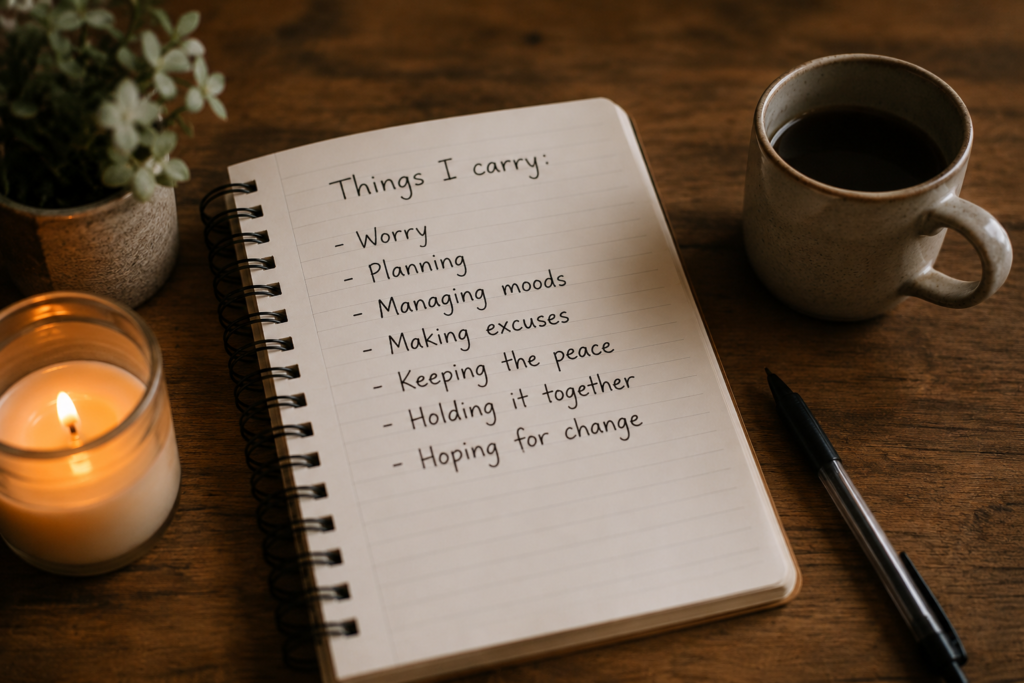
What am I carrying emotionally that no one else can see?
Not just practically. Emotionally.
Are you carrying fear? Shame? Responsibility? Hope? Disappointment? Family tension? Their guilt? Their defensiveness? The children’s confusion? The pressure to keep things looking normal? The belief that if you get it right, things might finally change?
Write it down if you can. Not to judge yourself, but to see it clearly.
Because once you can name what you are carrying, you can begin to ask a different question:
Is this mine to carry alone?
That question may not give you a neat answer immediately. But it can create a small space between you and the burden. And sometimes that small space is the beginning of getting yourself back.

You do not have to carry this alone
If you have been holding everything together, there is a good chance you are tired in a way sleep alone cannot fix. That does not mean you are broken. It means you have been doing too much invisible work for too long.
You are allowed to need support. You are allowed to want clarity. You are allowed to stop managing everyone else’s emotions at the expense of your own wellbeing.
You cannot make someone else stop using, drinking, lying, shutting down, relapsing, or avoiding responsibility. But you can begin to notice what the addiction has trained you to carry. You can begin to separate care from control. You can begin to rebuild your steadiness, your boundaries, and your sense of self.
You do not have to carry this alone.
Would it help to talk this through with someone?
Sometimes information is not enough. You may understand the patterns and still feel completely stuck when it comes to your situation.
I offer private one-to-one coaching for women affected by someone else’s addiction. Together, we can untangle what is happening, look honestly at what is and is not within your control, and help you decide on your next steady step.
You do not need to have everything figured out before you reach out.
If this article resonated with you, you may also find my free training, The List, helpful. It is designed for women who love someone with addiction and are tired of the chaos, confusion, and self-doubt. It will help you start seeing what is yours to carry — and what was never meant to belong to you.