When you love someone with an addiction, you can get pulled into invisible roles in the relationship without even realising it. Over time, it can start to feel like you are living the same scene on repeat.
Different day. Different crisis. Same emotional script.
They mess up.
You step in.
They promise things will be different.
You hope they mean it.
Something happens again.
You get angry, scared, hurt, or exhausted.
They accuse you of not understanding.
You defend yourself.
You explain.
You cry.
You rescue.
You pull away.
You come back.
Round and round it goes.
And somewhere in the middle of all that chaos, you may find yourself wondering:
How did I become this person?
You may not recognise yourself anymore.

Maybe you used to be calm, patient, confident, or clear-headed. Now you feel reactive. Snappy. Suspicious. Always bracing for the next problem.
Maybe you used to think of yourself as kind and generous. Now you feel resentful and hard.
Maybe you used to believe love meant showing up no matter what. Now you are starting to wonder whether “showing up” has slowly turned into disappearing from your own life.
This is where it can help to look at something I call the invisible roles.
Not because you need a psychology degree.
Not because you are broken.
And definitely not because this is at all your fault.
But because when you can finally see the pattern, you have a better chance of stepping out of it.
The invisible roles you may not realise you are playing
In many painful relationships, especially relationships affected by addiction, people can get pulled into roles.
These roles are not official. Nobody sits down and says, “Right, today I’ll be the rescuer and you can be the victim and later we’ll swap.”
Although, honestly, sometimes it’s so predictable you could nearly print a program.
These roles usually happen automatically.
They are emotional survival positions.
They are ways people try to get control, avoid pain, manage fear, or feel safe.
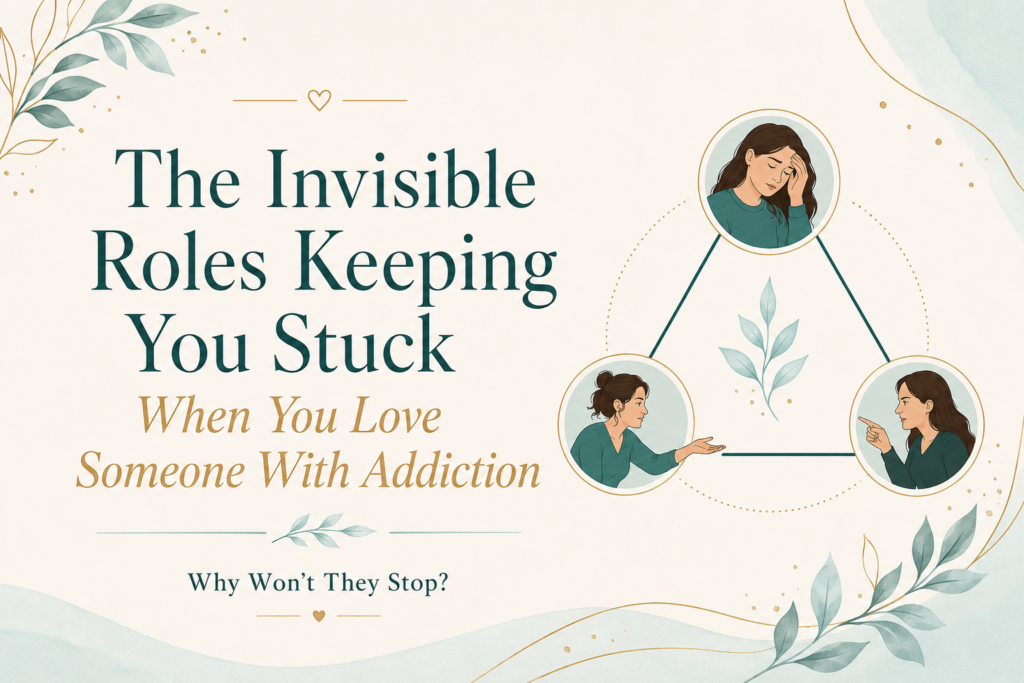
The three most common roles are:
The Rescuer
The Victim
The Persecutor
These roles are not official. Nobody sits down and says, “Right, today I’ll be the rescuer and you can be the victim and later we’ll swap.”
You may move between them without even realising it.
And so may the person you love.
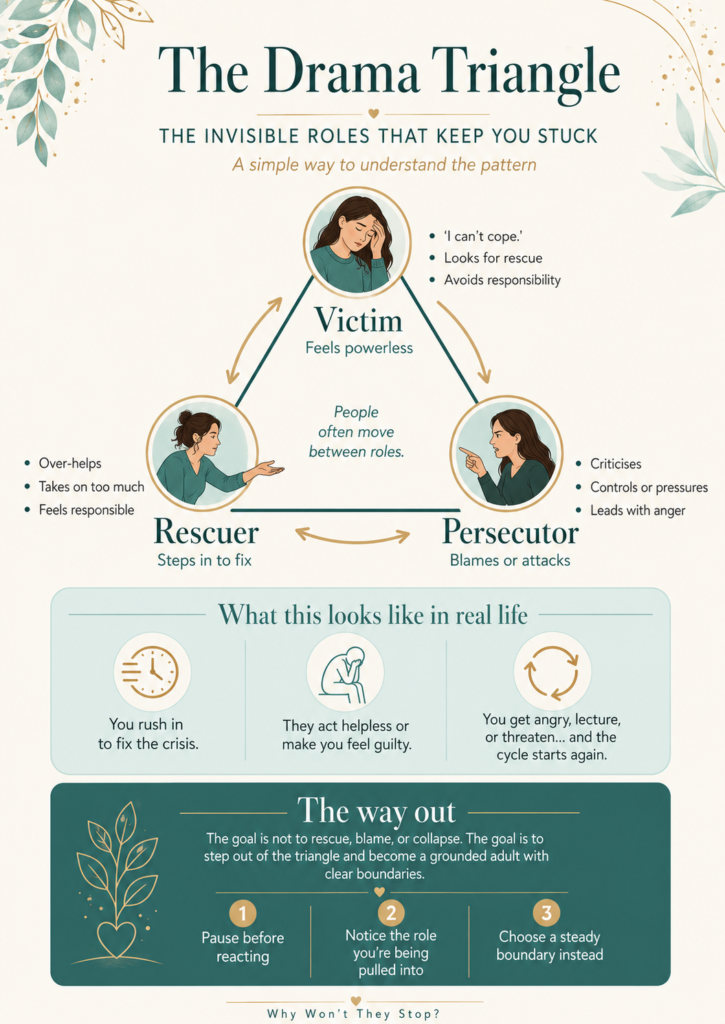
This pattern is sometimes known as the Drama Triangle, a simple model for understanding how people can move between rescuer, victim, and persecutor roles in conflict.
The problem is not that you are a bad person for stepping into these roles.
The problem is that once the roles take over, nobody is really relating honestly anymore.
Everyone is reacting.
Everyone is trying to survive the moment.
And nothing truly changes.
The Rescuer
This is where the line between care and rescue can become painfully blurred, which is why I wrote more about it in The Difference Between Care and Rescue.
The Rescuer is the one who steps in.
The one who fixes. Covers. Pays. Explains. Smooths things over. Picks up the pieces.
The Rescuer is the one who says:
“I’ll just help this once.”
“I can’t let them lose everything.”
“They have nobody else.”
“If I don’t do something, things will get worse.”
“I know I shouldn’t, but what else am I supposed to do?”
If you love someone with addiction, you may know this role very well.
You may have paid bills. Made excuses. Covered for them at work. Lied to family. Calmed the children. Replaced what was broken. Cleaned up the mess. Took the blame. Apologised for things you did not do.
And most likely, you did not do these things because you were stupid.
You did them because you cared.
You did them because you were scared.
You did them because the possible consequences felt unbearable.
You did them because, at the time, rescuing felt like the loving thing to do.
That is what makes this so hard.
Rescuing often looks like love from the outside.
But over time, rescuing can quietly become a trap.
Because the more you rescue, the more responsibility shifts onto you.
Their addiction creates the crisis, but somehow you become the emergency service.
Their choices create the fallout, but somehow you become the clean-up crew.
Their behaviour creates the instability, but somehow you become the one expected to keep everything together.
And eventually, the Rescuer becomes exhausted.
Not just tired.
Exhausted in the bones.
The kind of tired that sleep does not fix.
There are reasons you keep trying, even when every part of you is tired, and I explore those deeper emotional hooks in Why You Keep Trying Even When You’re Exhausted.

The Victim
The Victim role is not the same as being genuinely harmed. That is important.
If someone has lied to you, betrayed you, frightened you, stolen from you, manipulated you, or broken your trust, then yes — you have been hurt. Naming that is not “playing the victim.”
That is telling the truth.
The Victim role is different.
The Victim role is when someone becomes stuck in helplessness and uses that helplessness, consciously or unconsciously, to avoid responsibility.
The person with addiction may say things like:
“I can’t help it.”
“You don’t know how hard it is.”
“Everyone gives up on me.”
“You’re the only one who can help me.”
“If you loved me, you wouldn’t do this.”
“I may as well give up then.”
“You’re making things worse.”
This can pull you straight back into rescuing.
Because now the situation feels urgent again.
Now you feel cruel.
Now you feel responsible.
Now instead of asking, “What is theirs to deal with?” you are asking, “How do I stop them from falling apart?”
But here is the difficult truth:
Someone can be genuinely struggling and still be responsible for their behaviour.
Both can be true.
They may be in pain.
They may feel ashamed.
They may feel trapped.
They may need real support.
And still, it is not your job to become the container for every consequence of their addiction.
Their pain does not cancel out your limits.
Their struggle does not erase your right to safety, honesty, rest, and peace.
The Persecutor
This is the role nobody likes to talk about.
Because when you have been hurt over and over again, the last thing you want is to be told you are being “mean.”
So let’s be clear.
Having anger does not make you a bad person.
Feeling furious after repeated broken promises does not make you cruel.
Losing patience after years of chaos does not make you heartless.
Anger is often the part of you that finally says, “Enough.”
But sometimes, when you have spent too long rescuing and too long feeling helpless, you can swing into the Persecutor role.
This may sound like:
“How could you do this again?”
“You’re selfish.”
“You’re ruining everything.”
“You never change.”
“You always do this.”
“What is wrong with you?”
You may lecture. Interrogate. Threaten. Shame. Follow them around. Check their phone. Demand answers they are not capable of giving honestly. And for a moment, this can feel powerful.
Finally, you are not pleading.
Finally, you are not cleaning up.
Finally, you are saying what you really think.
But it still keeps you inside the same pattern.
Because the other person can then move into the Victim role.
They say you are attacking them.
They say you are the problem.
They focus on your tone instead of their behaviour.
And suddenly, you are defending how you said something instead of addressing what actually happened.
That is how the pattern protects itself.
It keeps everyone spinning.
If saying no makes you feel cruel, selfish, or sick with guilt, you may also find Why Saying No Feels So Guilty (Even When It’s Healthy) helpful.
How the roles move around
These roles are not fixed.
You might begin as the Rescuer:
“I’ll help you sort this out.”
Then become the Victim:
“I can’t believe I’m going through this again.”
Then become the Persecutor:
“I’m sick of your lies.”
Then feel guilty and return to the Rescuer:
“Fine. I’ll help, but this is the last time.”
And around it goes.
The person you love may move around too.
They may be the Victim when they want help.
Then become the Persecutor when you say no.
Then briefly become the Rescuer when they apologise and promise they will fix everything.
Then fall back into the same behaviour.
This is why addiction-affected relationships can feel so confusing.
You are not only dealing with the addiction.
You are dealing with the emotional roles that form around it.
In addiction relationships, these roles can become so familiar that they start to feel normal.
Painful, yes.
Exhausting, yes.
But normal.
Here’s a simple visual way to understand how these roles can move around:
The goal is not to become colder
When women start learning about boundaries, they sometimes worry that the only way out is to stop caring.
To become hard. Detached. Unfeeling.
But that is not the goal.
The goal is not to stop loving them.
The goal is not to punish them.
The goal is not to become someone you do not recognise.
The goal is to stop losing yourself inside the pattern.
There is a big difference between love and rescue.
There is a big difference between compassion and collapse.
There is a big difference between support and self-abandonment.
And there is a very big difference between being kind and being endlessly available for chaos.
The way out is not becoming cold.
The way out is becoming clear.

The shift: from Rescuer to regulated adult
This is the part I want you to sit with.
The goal is not to become their rescuer.
It is not to become their coach.
It is not to become their judge.
It is not to become their emotional referee.
Once you can see the invisible roles, you can begin choosing a different response.
The goal is to become a regulated adult with boundaries.
That may sound simple, but it is not always easy.
A regulated adult with boundaries can say:
“I love you, and I’m not giving you money.”
“I care about what happens to you, and I’m not lying for you.”
“I hear that you’re upset, and I’m not continuing this conversation while you’re yelling.”
“I hope you get help, and I’m not making your recovery my responsibility.”
“I’m willing to support healthy choices, but I won’t protect you from every consequence.”
This is not dramatic.
It is not cruel.
It is not abandoning.
It is steady.
And steady can feel very strange when you are used to chaos.
At first, steadiness may feel wrong.
You may feel guilty.
You may feel mean.
You may feel like you are doing nothing.
But often, what feels like “doing nothing” is actually you refusing to play your old role.
That is not nothing.
That is change.
A simple way to recognise the role you are in
When you feel pulled into the familiar chaos, pause and ask yourself:
What role am I being invited into right now?
Am I being invited to rescue?
Am I being invited to take responsibility for something that is not mine?
Am I being invited to become the villain because I said no?
Am I being invited into another argument that will go nowhere?
You do not have to answer perfectly.
You are simply creating a gap.
And that gap matters.
Because the pattern needs you to react quickly.
It needs urgency.
It needs guilt.
It needs panic.
It needs you to act before you have time to think.
So even a small pause can interrupt the cycle.
A breath.
A walk outside.
A text you do not answer immediately.
A sentence you write down before you say it.
A decision you sleep on.
These may not look impressive from the outside.
But they are acts of self-protection.
What stepping out might look like
Stepping out of the roles does not always mean a big dramatic confrontation.
Sometimes it looks very ordinary.
It might look like saying:
“I’m not discussing this while you’re intoxicated.”
“I’m going to take some time before I respond.”
“I’m not able to help with that.”
“I’m sorry you’re struggling. I hope you contact someone who can support you properly.”
“I’m not going to argue about whether my boundary is fair.”
It might look like not explaining yourself for the fifteenth time.
It might look like letting the phone ring.
It might look like refusing to turn one more crisis into your full-time job.
It might look like going to bed.
It might look like eating dinner.
It might look like taking your own life seriously again.
This is where people often misunderstand boundaries.
They think boundaries are mainly about controlling the other person.
But real boundaries are about how you will care for yourself when the other person makes their own choices.
A boundary does not say:
“You must stop drinking.”
It says:
“I will not stay in the room when you are drunk and aggressive.”
A boundary does not say:
“You must stop using.”
It says:
“I will not give you money.”
A boundary does not say:
“You must tell me the truth.”
It says:
“I will make decisions based on behaviour, not promises.”
That is a very different kind of power.
Quieter.
Cleaner.
Harder to argue with.
But what if something bad happens?
This is the fear underneath so much rescuing.
What if I say no and they lose everything?
What if I do not answer and they spiral?
What if I stop helping and something terrible happens?
These are not silly fears.
They are real fears.
When addiction is involved, the stakes can feel terrifying.
And if there is immediate danger, violence, overdose risk, threats of suicide, child safety concerns, or someone is at risk right now, then the response needs to be immediate and practical. Contact emergency services or a crisis support service in your area. Do not try to handle danger alone.
But outside of immediate danger, this is the painful truth:
You cannot build a safe life by personally absorbing every possible consequence of another adult’s choices.
You can love them.
You can encourage help.
You can support recovery-focused action.
You can make wise decisions about safety.
But you cannot become the wall that stands between them and every outcome.
That wall will eventually fall on you.
And then there are two people drowning instead of one.
If you have been protecting them from consequences because you are terrified of what might happen, When Helping Keeps Them Sick may help you look at that pattern with more clarity and less shame.
You are allowed to leave the role
One of the hardest parts of stepping out of these roles is that other people may not like it.
Especially if they benefited from the role you used to play.
If you stop rescuing, they may call you selfish.
If you stop arguing, they may accuse you of not caring.
If you stop explaining, they may say you are cold.
If you stop fixing, they may say you have changed.
And maybe you have.
Maybe you are changing from someone who reacts to every crisis into someone who thinks before she responds.
Maybe you are changing from someone who confuses guilt with responsibility into someone who can tell the difference.
Maybe you are changing from someone who has been living on emotional crumbs into someone who remembers she is allowed to have a life too.
That kind of change can unsettle the old pattern.
Good.
Some patterns need to be unsettled.
A question to sit with
The next time you feel pulled back into the same exhausting cycle, ask yourself:
Who do I become in this pattern?
Not to shame yourself.
Not to blame yourself.
But to notice.
Do I become the fixer?
The pleader?
The detective?
The lecturer?
The emotional shock absorber?
The one who abandons herself so nobody else has to feel uncomfortable?
Then ask:
Who would I be if I stepped out of that role for one moment?
Not forever.
Not perfectly.
Just for one moment.
Maybe you would be quieter.
Maybe you would be firmer.
Maybe you would be kinder to yourself.
Maybe you would let the consequence belong where it belongs.
Maybe you would stop trying to win an argument with addiction and start protecting your own peace.
That is not giving up.
That is waking up.
Final thought
When you love someone with addiction, it is easy to get pulled into roles you never chose.
Rescuer.
Victim.
Persecutor.
Fixer.
Watcher.
Referee.
Protector.
The strong one.
The responsible one.
The one who keeps everything from falling apart.
But you are not here to play a role until there is nothing left of you.
You are a person.
A whole person.
With needs, limits, wisdom, grief, anger, love, and a life that still belongs to you.
You cannot make them stop.
But you can begin to stop stepping into the same role every time the chaos calls your name.
And that may be one of the first real ways you start coming back to yourself.
This week’s reflection
Where do I most often get pulled in?
- Rescuing?
- Explaining?
- Defending?
- Fixing?
- Monitoring?
- Arguing?
- Taking responsibility for consequences that are not mine?
And what would it look like to pause before stepping into that role again?
Not sure what to do next?
Start with The List — my free short training designed to help you separate what is within your control from what is not, see where helping may have become rescuing, and begin making clearer decisions about what happens next.
You do not need to solve everything today.
You only need to take the next honest step.