If someone you love is drinking or using drugs in a way that is harming them and everyone around them, you have probably asked this question many times:
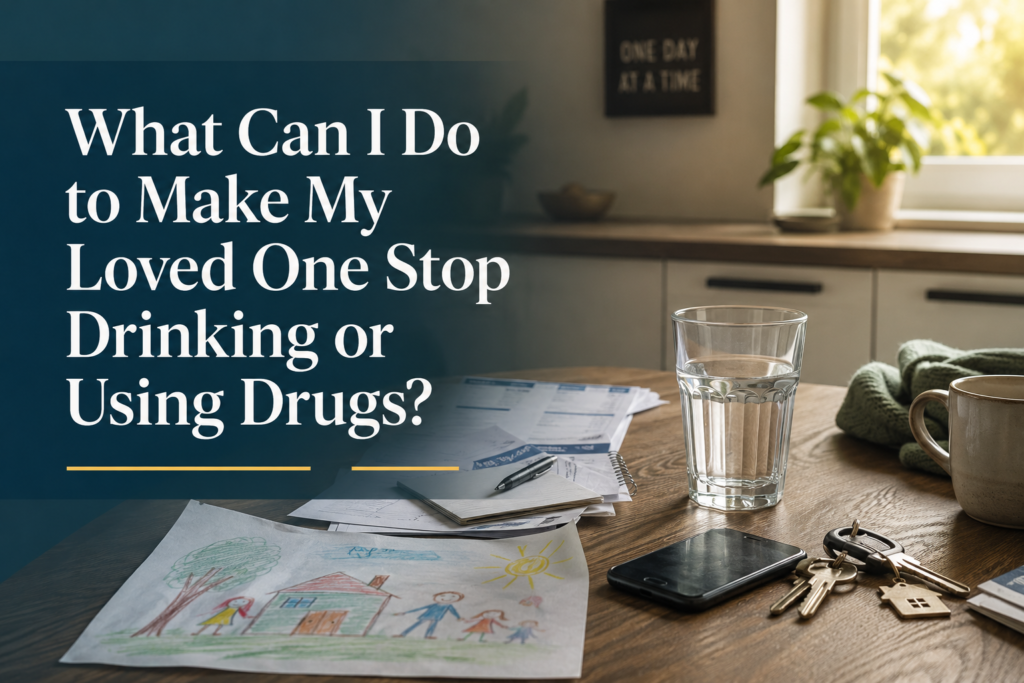
What can I do to make them stop?
You may have tried reasoning with them, pleading with them, becoming angry, remaining calm, finding treatment programs, making appointments, issuing warnings, offering incentives and giving them another chance.
You may have tried stepping in to prevent the next crisis. You may also have tried stepping back, only to become frightened about what could happen if you did nothing.
Of course you want something that works. You can see the damage being done, and it may seem impossible that the person you love cannot or will not see it clearly enough to change.
The honest answer is that you cannot make another adult stop drinking or using drugs. You cannot create their willingness, complete treatment for them or guarantee their recovery.
However, that does not mean you are powerless.
You can change how you respond. You can stop taking responsibility for choices that belong to them. You can protect your children, finances, home and wellbeing. You can offer appropriate support without taking over. You can also change relationship patterns that may have developed around the addiction.
None of these actions can guarantee that your loved one will stop. They can help you respond more effectively and stop their addiction from controlling every part of your life.
Why Can’t I Make Them Stop?
It is natural to believe that if you could find the right words, your loved one would finally understand.
You may explain the health risks, the financial damage, the effect on the children and what their behaviour is doing to the relationship. You may remind them of who they used to be and what they could lose.
They may agree with you. They may become defensive, blame you or insist that the problem is not as serious as you think. They may promise to stop and appear completely sincere when they say it.
The difficulty is that understanding the consequences of addiction is not the same as being ready or able to change.
Addiction affects motivation, judgement, impulse control and behaviour. A person can know that alcohol or drugs are harming them and still continue. They may also feel ashamed, frightened of withdrawal, uncertain about treatment or unwilling to imagine life without the substance.
This is why logic and love are not always enough. It is not because you have explained it badly or failed to care enough. I explore this further in Why Logic Doesn’t Work With Addiction.
Your loved one must eventually take ownership of their own recovery. You may be able to encourage and support that process, but you cannot do it on their behalf.
Sometimes You Are Responding to Real Risk
Advice about addiction often tells family members to let go, stop monitoring and allow the person to experience the consequences of their behaviour.
That advice can be useful, but it can also be too simplistic.
You may not be worrying about imaginary dangers. Your loved one’s choices may genuinely threaten your financial security, housing, sleep, employment or physical safety.
Money needed for rent, mortgage payments, food or electricity may be disappearing. Debts may be accumulating in both names. Your loved one may be driving while intoxicated, bringing unsafe people into the home, becoming aggressive or leaving children without adequate supervision.
You may be staying awake because you do not know whether they will return home, start an argument, fall and injure themselves or wake the whole household. You may be checking on them because there have already been overdoses, medical emergencies, accidents or threats of self-harm.
In these circumstances, you are not simply being controlling. You may be trying to prevent foreseeable harm and keep the household functioning.
The more useful question is not, “How do I stop trying to control everything?”
It is:
What genuinely protects us, and what only keeps me trapped in constant crisis management?
Protecting children, limiting access to shared money, securing important documents, refusing to allow intoxicated driving and seeking professional advice are not punishments. They are reasonable responses to risk.
You do not have to leave your children, finances or safety exposed in order to prove that you are no longer rescuing someone.
Control and Influence Are Not the Same Thing
You cannot control whether your loved one drinks, uses drugs, attends treatment, tells the truth or remains in recovery.
You do have influence over the environment and the relationship.
You can decide how you communicate, what behaviour you will tolerate and what help you are willing to provide. You can stop covering up, stop financing behaviour that may be harmful and stop accepting responsibility for every consequence.
Your response may influence what happens next. It may make it easier for your loved one to seek help, reduce some of the conflict around the addiction or stop protecting the addiction from its consequences.
Influence is not a guarantee.
This distinction matters because otherwise you can become responsible for every outcome. If you rescue and they continue using, you blame yourself for enabling them. If you stop rescuing and they still continue, you blame yourself for failing to set the right boundary.
Their recovery is not a test of whether you responded perfectly.
You can influence the relationship. You cannot own the result.

Stop Repeating Conversations That Go Nowhere
You have the right to speak honestly about how the drinking or drug use affects you.
A clear conversation may help your loved one understand what you have observed and what support is available. It may also give you an opportunity to explain what you will do if the situation continues.
However, repeatedly presenting the same evidence often leads to circular arguments.
You explain what happened. They deny it, minimise it or offer another reason. You produce more evidence. They become defensive. The original problem becomes lost in an argument about details, tone or blame.
More words do not always produce more understanding.
Try to speak when your loved one is reasonably sober and the situation is calm enough for a conversation. Focus on specific behaviour and its effect rather than attacking their character.
You might say:
“When money for the household is spent on alcohol, I cannot cover the bills. I am changing how our shared money is managed.”
This is clearer than trying to prove that they are selfish, irresponsible or an alcoholic.
The Alcohol and Drug Foundation provides useful guidance on starting a conversation about alcohol or other drug use.
Stop Rescuing From Every Consequence
Rescuing can begin with a genuine emergency.
You pay a bill because the electricity is about to be disconnected. You collect them because they are unsafe. You call their employer because they cannot go to work. You give them money because they claim they have nowhere else to turn.
There will be situations in which helping is appropriate. Children, urgent medical needs and immediate safety must be considered.
The problem develops when you routinely take responsibility for consequences created by another adult’s choices.
You may cover missed work, pay repeated debts, lie to relatives, replace damaged belongings or solve every practical problem left behind by their drinking or drug use.
This can protect them from some consequences while transferring those consequences to you.
Allowing an appropriate consequence to remain with the person who created it is not cruel. It is also not a technique for forcing them to reach “rock bottom.” They may experience the consequence and still continue using.
The purpose is not to make them change. It is to stop taking ownership of something that does not belong to you.
You can read more about this distinction in The Difference Between Care and Rescue and When You Feel Responsible for Their Recovery.
Stop Making Threats You Cannot Carry Out
Threats often happen when you feel frightened and powerless.
You may say that this is the last time, that you will leave, that they will no longer see the children or that you will never help again.
You may mean it in that moment. Later, when the immediate crisis has passed, the consequences feel too difficult, unsafe or complicated to carry out.
This does not mean you are weak. It may mean the threat was made during a crisis before you had decided what you were genuinely prepared to do.
A workable boundary describes your action rather than trying to command theirs.
“I will not remain in the room when you are shouting at me” is different from “You are not allowed to become angry.”
“I will not give you cash” is different from “You have to stop using drugs.”
A smaller boundary that you can maintain is more useful than a severe ultimatum that neither of you believes will happen.
You may find Boundaries Are Not Ultimatums helpful when deciding what a realistic boundary might look like in your situation.
Start Protecting What Is Yours to Protect
Stepping back from over-responsibility does not mean abandoning practical protection.
You may need to take action to protect access to money, housing, vehicles, important documents, medication and children.
Depending on your circumstances, this could include opening an account in your own name, changing passwords, reviewing joint debts, securing identity documents or obtaining financial and legal advice.
You may need a clear plan for who can collect the children, where you can go during an unsafe incident or whom you can call if your loved one becomes threatening or severely impaired.
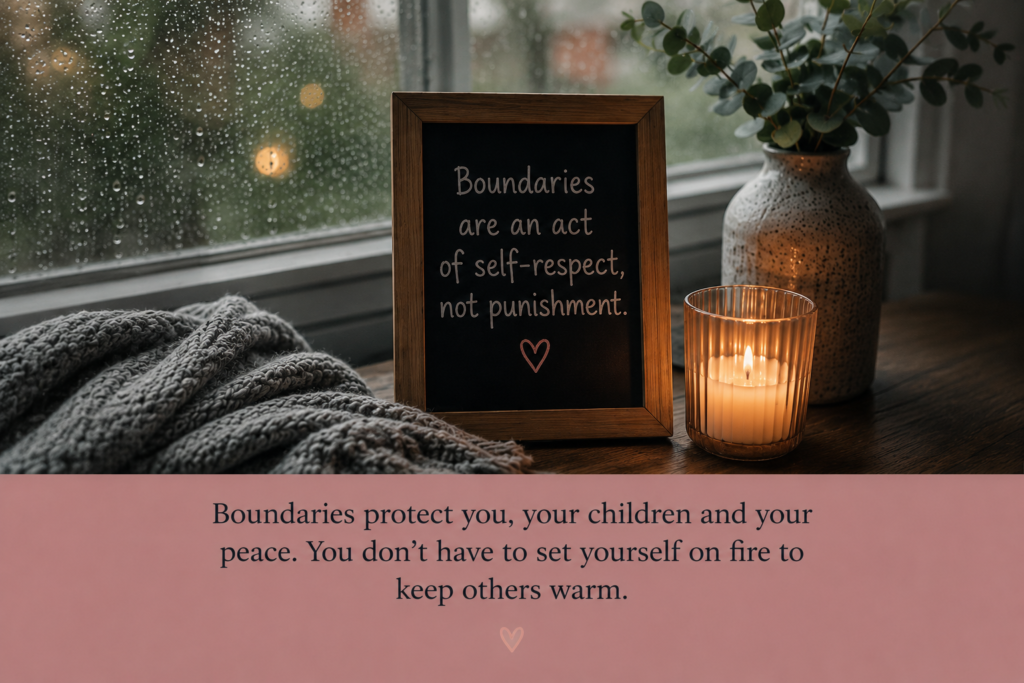
These actions are not about punishing the person with the addiction. They are about reducing preventable harm.
You should not have to lose the family’s financial security before you are considered entitled to act. You do not have to wait for a child to be placed in danger before deciding that intoxicated driving or inadequate supervision is unacceptable.
You are allowed to respond to what has already happened rather than waiting for the worst possible outcome.
Start Offering Support Without Taking Over
There are ways to support someone who may be willing to consider change.
You can give them information about treatment services, encourage them to speak with a doctor and offer practical assistance with a genuine recovery step.
For example, you may offer transport to an appointment, help them locate a service or care for children while they attend treatment.
Support becomes takeover when you arrange everything, chase every appointment, manage their communication and become more invested in the treatment than they are.
You can open a door. They still have to walk through it.
The Alcohol and Drug Foundation’s guidance for families explains that a person must be willing to seek help, while family members can continue offering information, encouraging safer choices and establishing realistic boundaries. You can read more in My Loved One Doesn’t Want Help.
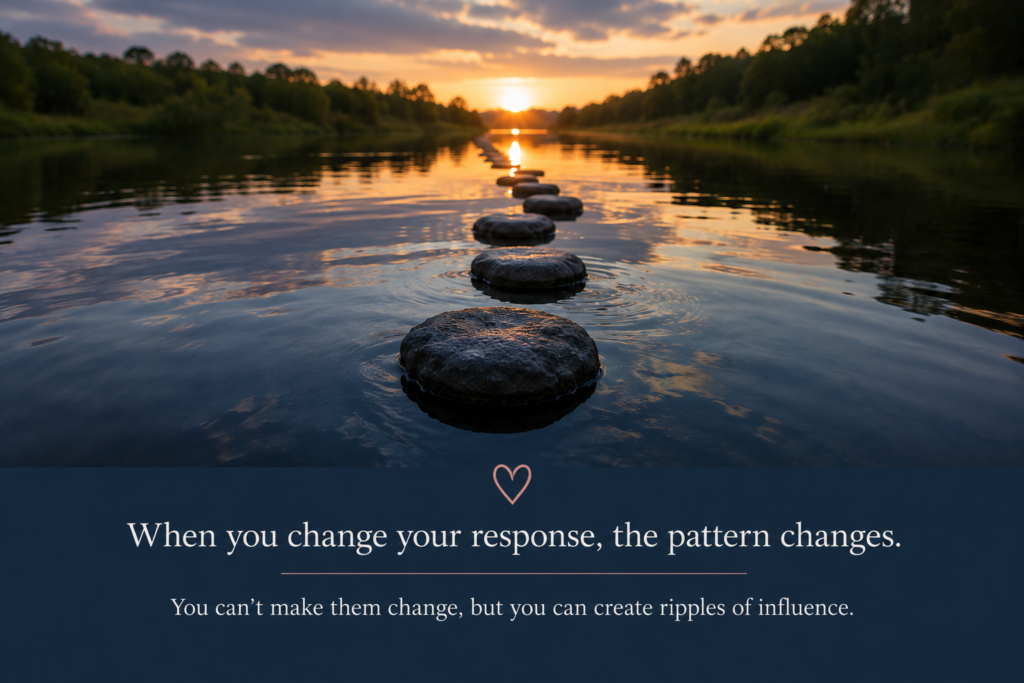
When You Change Your Response, the Relationship Changes
Relationships develop repeated patterns.
One person drinks or uses. The other confronts, rescues, monitors, threatens or withdraws. There may be an argument, a crisis, an apology and a period of hope. The cycle then begins again.
When you change your response, the old pattern cannot continue in exactly the same way.
You may stop arguing for hours. You may no longer provide money after a crisis. You may leave the room when the conversation becomes abusive. You may refuse to lie to an employer or family member.
This does not mean your loved one will stop drinking or using. It does mean the relationship has changed because one part of the established cycle is no longer operating as it did before.
Responding more calmly and consistently can also provide a healthier model. You demonstrate clearer communication, personal responsibility and a willingness to act according to your stated limits.
That can have a positive influence. Your loved one may begin to see that conversations do not need to become shouting matches and that choices have consequences other people will no longer absorb.
However, modelling a better response is not another strategy for controlling them. You are not remaining calm so that they will become calm or setting boundaries so that they will choose recovery.
You are responding differently because it is a healthier and more sustainable way for you to live.
Expect Some Pushback When the Pattern Changes
When an established response stops working, the other person may try harder to obtain it.
They may accuse you of being selfish, cold or uncaring. They may increase the pressure, make urgent promises, become angry or create another crisis that pulls you back into your old role.
This is not always calculated manipulation. People often repeat behaviour that has worked before, especially when they are distressed or frightened.
If anger caused you to give in previously, more anger may follow when you do not. If a crisis usually resulted in money, transport or rescue, the urgency may increase when your answer changes.
Pushback does not automatically mean your new response is wrong.
It is still important to review the boundary honestly. Is it safe? Is it realistic? Is it based on something you can control? Can you maintain it?
You may also discover that a boundary needs practical preparation. Saying you will leave an unsafe situation is difficult if you have nowhere to go, no access to money or children who need to be moved safely.
Consistency matters, but safety matters more. If maintaining a boundary places you or your children in immediate danger, seek specialist help rather than trying to prove that you can hold your ground.
Do Not Turn Stepping Back Into Another Way to Control Them
It is easy to think:
“If I stop rescuing, they will finally understand.”
This still makes your action dependent on their reaction.
You may stop rescuing and find that they continue drinking or using. They may blame you, find someone else to help or experience serious consequences without changing.
That does not mean your boundary failed.
A boundary may be successful because it protected your finances, reduced your involvement in repeated crises or allowed you to act in accordance with your values.
The measure is not only whether they stopped.
A healthier position is:
“I am changing how I respond because I cannot continue living this way. What they choose to do with that change belongs to them.”
When This Is a Safety Issue
Some situations require immediate action rather than another conversation.
Call emergency services if you suspect an overdose, if someone is unconscious or having difficulty breathing, or if there is an immediate threat of violence or serious harm.
Alcohol withdrawal can also be medically dangerous. A person who is physically dependent on alcohol should seek medical advice rather than suddenly attempting to stop without appropriate support.
Take threats of suicide or self-harm seriously. Contact emergency or crisis services rather than trying to manage the situation alone.
If children are unsafe, being transported by an intoxicated driver or exposed to violence, you may need professional child-safety, legal or domestic-violence advice.
In Australia, call 000 in an immediate emergency. The National Alcohol and Other Drug Hotline on 1800 250 015 provides confidential information, support and referrals for people affected by alcohol and other drug use, including family members.
Readers outside Australia should contact their local emergency, addiction or family-safety services.
What Is Actually Yours to Do?
You can decide what behaviour you will participate in and what you will no longer cover up.
You can decide how money you control will be managed. You can make plans to protect children and seek professional advice about shared finances, housing or safety.
You can choose how you speak, when you end a conversation and what support you are prepared to offer.
You can get help for yourself even when your loved one refuses help.
You cannot decide whether they admit there is a problem, attend treatment, tell the truth or remain in recovery.
You cannot decide whether they approve of your boundary or blame you for changing.
Their choices belong to them. Your safety, decisions and life belong to you.
This is not always a neat division. When lives, finances and children are shared, their choices have real consequences for you. The aim is not to pretend that you are unaffected. It is to become clearer about where you have authority and where you do not.
Knowing What to Do Is Not the Hardest Part
You may already know that you should set boundaries, stop rescuing or take better care of yourself.
The difficult part often comes later.
It comes when your loved one becomes angry, when guilt tells you that you are abandoning them or when another crisis makes the old response feel easier.
It comes when family members disagree with you, when children are upset or when you begin to question whether the situation was really as bad as you thought.
Changing an established response takes practice. It also helps to have support from people who understand why a simple decision can become so difficult when addiction is involved.
Need something practical to help right now?
You do not have to figure all of this out in your head.
I’ve created a library of free guides, worksheets and practical resources to help you make sense of what is happening, strengthen your boundaries and work out your next steady step.
You Cannot Make Them Stop, but You Are Not Powerless
You cannot make another adult stop drinking or using drugs.
You can offer appropriate support, communicate clearly and protect what is yours to protect. You can stop absorbing every consequence and begin responding in ways that are safer and more sustainable.
Changing your response may create positive changes in the relationship. It may also create resistance because the old pattern is no longer working in the same way.
What happens next is not entirely within your control.
You do not have to solve their addiction before you begin making your own life safer and steadier.
Their recovery belongs to them. Your life is still yours.