When someone you love is struggling with addiction, helping can feel like the most natural thing in the world.
You try to smooth things over.
You step in when things fall apart.
You make phone calls, offer money, tell small lies to protect them, or quietly clean up the mess.
Most women do these things for one simple reason.
They care.
They care about the person they love.
They care about the damage addiction is causing.
They care about keeping the family together.
Helping feels like love in action.
But there is a painful truth many women eventually discover.
Sometimes the very things done out of love are the same things that allow the addiction to continue.
Not because you are foolish.
Not because you don’t care enough.
But because addiction quietly reorganises the entire relationship around protecting the addicted person from consequences.
And when consequences disappear, addiction can keep going for a very long time.
Why Helping Feels So Necessary
When someone you love is struggling, doing nothing can feel unbearable.
You see the chaos.
You see the pain.
You see the damage spreading through work, finances, relationships, and health.
Your instinct is to step in and stabilise things.
You might:
- Pay bills they can’t manage
- Call their boss to explain an absence
- Cover for them with family or friends
- Drive them places when they are not functioning
- Calm down situations that could explode
- Fix problems before anyone else notices
Each action feels like protection.
And in the short term, it often does protect them.
The crisis is avoided.
The argument is postponed.
The embarrassment is hidden.
Things settle down — at least for a while.
But something important is happening underneath the surface.
The addiction is quietly being shielded from the consequences it would normally create.
Many women slide slowly from caring into rescuing without even noticing. If you haven’t read it yet, it can be helpful to understand the difference between care and rescue, because that shift often happens quietly.

The Invisible System Around Addiction
Addiction rarely operates in isolation.
Over time, a system begins to form around it.
Addiction has a powerful way of reorganising the entire relationship around it. If you’re new to these ideas, it can help to start with understanding addiction without blaming yourself, which explains why these patterns form in the first place.
People adjust their behaviour to keep the peace.
Responsibilities shift.
Other family members carry more weight.
The person struggling with addiction may still experience consequences — but often those consequences are softened, delayed, or absorbed by someone else.
Many women find themselves becoming the stabiliser in this system.
They hold things together.
They manage the fallout.
They try to prevent the worst outcomes.
It can feel like the only responsible choice.
But it also creates a difficult dynamic.
The addiction continues to cause damage — but someone else keeps absorbing the impact.
Borrowed Consequences
Addiction often survives because someone else is quietly carrying the consequences.
One way to understand this pattern is through the idea of borrowed consequences.
Consequences are the natural results of our actions.
If someone drinks heavily and misses work, the natural consequence might be a warning from their employer.
If someone spends money on substances, the natural consequence might be financial pressure.
If someone behaves unpredictably while intoxicated, the natural consequence might be damaged relationships.
But when someone else steps in to repair those outcomes, the consequences don’t disappear.
They are simply borrowed by someone else.
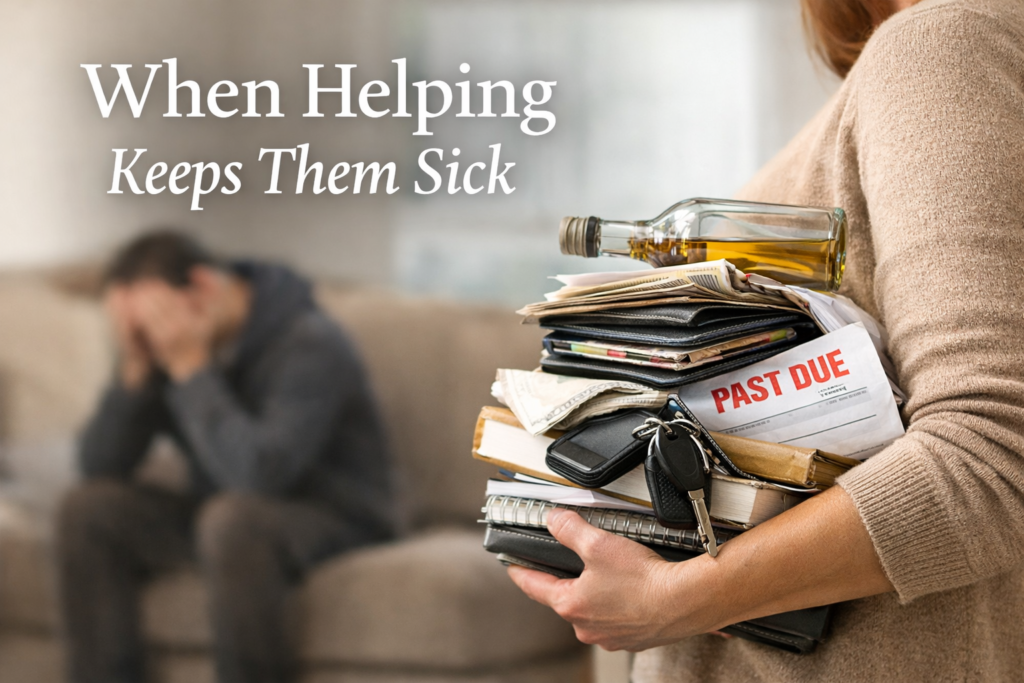
The partner pays the bill.
The parent smooths things over.
The spouse explains away the behaviour.
The addicted person is temporarily protected.
But the cost doesn’t vanish.
It is quietly carried by the person who stepped in.
Addiction specialists often describe this pattern as enabling, where attempts to protect someone from the consequences of addiction can unintentionally allow the behaviour to continue. The concept is widely discussed in addiction treatment resources such as those from the Mayo Clinic.
Over time, many women supporting someone with addiction begin living under a heavy load of borrowed consequences.
Financial stress.
Emotional exhaustion.
Constant anxiety about what might happen next.
And yet the addiction itself continues largely unchanged.
Every time you step in to absorb the consequences of the addiction, the addiction gets a little more comfortable staying.

Why This Is So Hard to See
For many women, recognising this dynamic can feel deeply uncomfortable.
Helping feels like love.
Stepping back can feel like cruelty.
There is often a powerful fear sitting underneath it all:
If I stop helping, something terrible might happen.
That fear is understandable.
Addiction can be chaotic and unpredictable.
But it is also important to remember something many people overlook.
No one person has the power to control another adult’s addiction.
Not through love.
Not through sacrifice.
Not through endless effort.
The addiction will continue or change based on choices the addicted person eventually has to make themselves.
And those choices often become clearer when the consequences of the addiction are no longer being absorbed by someone else.
Helping vs Holding the Addiction Up
Supporting someone through addiction is one of the most complex emotional situations a person can face.
There is no simple formula.
But one helpful question many women begin asking themselves is this:
Am I supporting recovery — or am I unintentionally holding the addiction up?
Support might look like:
- Encouraging treatment
- Being emotionally present without taking responsibility for their choices
- Protecting your own wellbeing
- Allowing natural consequences to occur
Holding the addiction up often looks different.
It involves constantly preventing the fallout, fixing the damage, and keeping everything functioning around the addiction.
And over time, that role can quietly drain the life out of the person trying to hold everything together.
A Difficult Realisation
One of the hardest moments for many women comes when they realise this:
Helping more has not stopped the addiction.
Not because they didn’t love enough.
But because addiction does not respond to sacrifice the way we hope it will.
This realisation can feel painful at first.
But it can also open the door to something important.
The possibility of stepping out of the role of constant rescuer.
The possibility of letting responsibility return to the person whose life it actually is.
And the possibility of beginning to rebuild your own steadiness again.

You Are Not Responsible for Holding Everything Together
If you recognise yourself in any of these patterns, please know something important.
You did not create the addiction.
And you are not responsible for carrying its consequences alone.
Most women who find themselves here were simply trying to protect someone they love.
That instinct comes from care, loyalty, and compassion.
Those are not weaknesses.
But protecting someone from the consequences of addiction can quietly trap you in a role that keeps the entire cycle running.
Learning to step out of that role is not abandonment.
Often, it is the first step toward restoring balance — both for you and for the person struggling.
A Gentle Place to Start
If this idea feels confronting, you are not alone.
Many women need time to sit with it.
You might start by simply noticing when you step in to prevent a consequence.
Ask yourself:
Is this truly helping?
Or am I carrying something that was never meant to be mine?
That awareness alone can begin to shift the dynamic.
If You Missed the Previous Article
If this idea feels confronting, you may also recognise the powerful guilt that appears when you begin setting limits. We explored that in the previous article about why saying no can feel so guilty, even when it’s healthy.
If this article stirred something for you, you may find that discussion helpful as well.
You can read it here:
Why Saying No Feels So Guilty (Even When It’s Healthy)
Not sure what to do next?
Start with The List — my free short training designed to help you separate what is within your control from what is not, see where helping may have become rescuing, and begin making clearer decisions about what happens next.
You do not need to solve everything today.
You only need to take the next honest step.