At first, it’s subtle.
They’re still mostly themselves. Same laugh. Same face. Same voice.
But something is… off.
They’re sharper. Quieter. Less present. More defensive.
Or weirdly charming when they need something.
You tell yourself you’re imagining it.
You’re tired. Sensitive. Overthinking.
But you’re not.
Addiction doesn’t just change behaviour.
It changes who shows up in the room.
And that’s what breaks your heart.
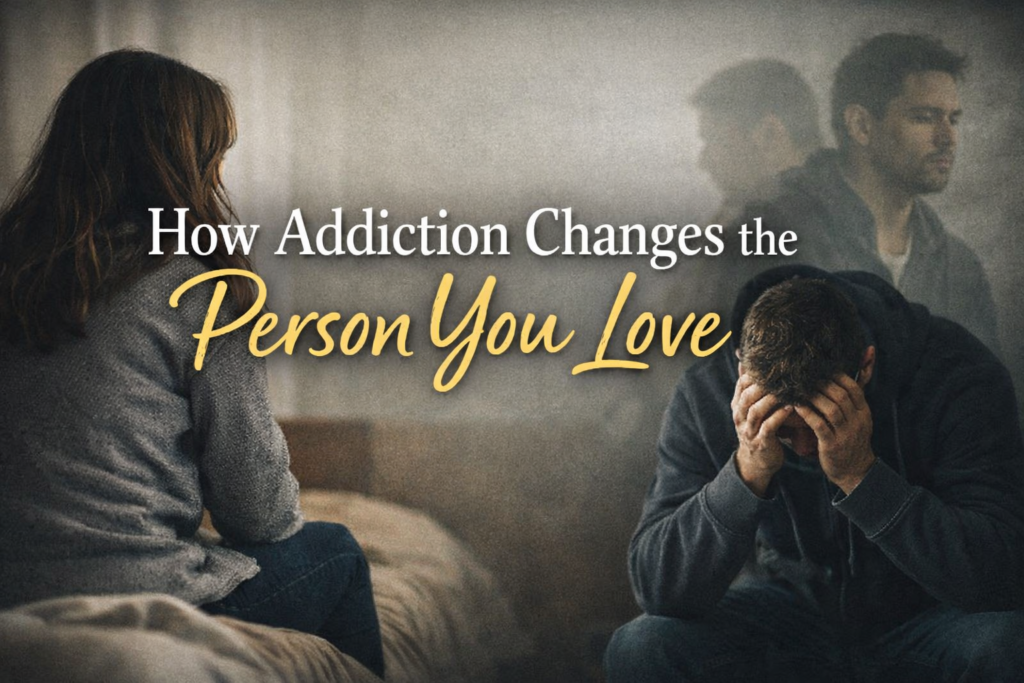
It Feels Like You’re Talking to Two Different People
Some days, they’re there.
They look at you like they used to.
They joke. They care. They sound like the person you fell in love with.
And you think,
“See? They’re still in there. I just have to hold on a bit longer.”
Then the switch flips.
Same face. Different energy.
Cold. Distant. Defensive. Blaming. Lying. Avoiding.
Suddenly everything is your fault, or nothing is wrong, or you’re “making a big deal out of nothing.”
You start to wonder if you’re losing your mind.
You’re not.
You’re living with two versions of the same person:
- The one you love
- And the one addiction puts in charge
And they don’t behave the same way.
Why Addiction Changes Them
Addiction isn’t just a habit.
It rewires priorities.
It teaches the brain one brutal rule:
“Protect the substance at all costs.”
That means:
- Truth becomes optional
- Connection becomes risky
- Accountability becomes a threat
- You become an obstacle if you get in the way
So the person you love learns to:
- Hide
- Minimise
- Blame
- Charm
- Attack
- Withdraw
Not because they’re evil.
But because addiction is in survival mode.
And survival doesn’t care who it hurts.
If you’re reading this and thinking, “But why would they act like this? Why would someone who loves me do these things?” — that question deserves a real answer.
Addiction isn’t about a lack of love or willpower. It’s about how the brain gets hijacked.
I explain that in more depth in this post:
Why Won’t They Stop? Understanding Addiction Without Blaming Yourself
The Quiet Grief No One Talks About
Here’s the part that no one prepares you for:
You don’t just lose trust.
You lose them.
Not in one big dramatic moment.
In tiny pieces.
You grieve:
- The way they used to look at you
- The way conversations used to flow
- The safety you felt around them
- The future you assumed you were building together
But they’re still standing in front of you.
So you’re grieving someone who is still alive.
And that is a special kind of hell.
Because:
- You can’t fully mourn
- You can’t fully let go
- And you can’t go back to how it was
You’re stuck loving a memory and managing a reality that doesn’t match it.

Loving Someone Who Feels Gone
This is why it hurts so much.
You’re not just dealing with addiction.
You’re dealing with absence.
They’re there physically…
But emotionally, mentally, relationally — they’re often not.
And you keep trying:
- To reach them
- To remind them
- To wake them up
- To bring them back
Because somewhere inside you is the belief:
“If I love them hard enough, the real them will stay.”
But love doesn’t cure addiction.
And it’s not your job to fight a disease with your heart.
The Hard Truth
Here it is, plain and unsugared:
You can love the person.
And still name the addiction as destructive.
You can miss who they were.
Without pretending who they are now is okay.
You can hold compassion.
Without sacrificing yourself on the altar of hope.
And you are not weak for grieving someone who is still breathing.
That grief makes sense.
Because the person you love didn’t disappear all at once.
They faded in front of you.
And you had to keep loving them anyway.
That’s not weakness.
That’s brutal, beautiful, heartbreaking loyalty.
The question now isn’t:
“How do I get them back?”
It’s:
“How do I stay myself while loving someone who is changing?”
And that…
Is where your real work begins.

If this post named something you’ve been holding quietly, you don’t have to hold it alone.
You have two gentle ways to stay connected:
- Join the free WWTS community — a calm, private space for women who love someone with addiction and are trying to stay themselves while they do.
- Or receive my weekly email — steady, honest words to help you make sense of what you’re living, without blame or hype.
No fixing. No shaming. Just understanding.