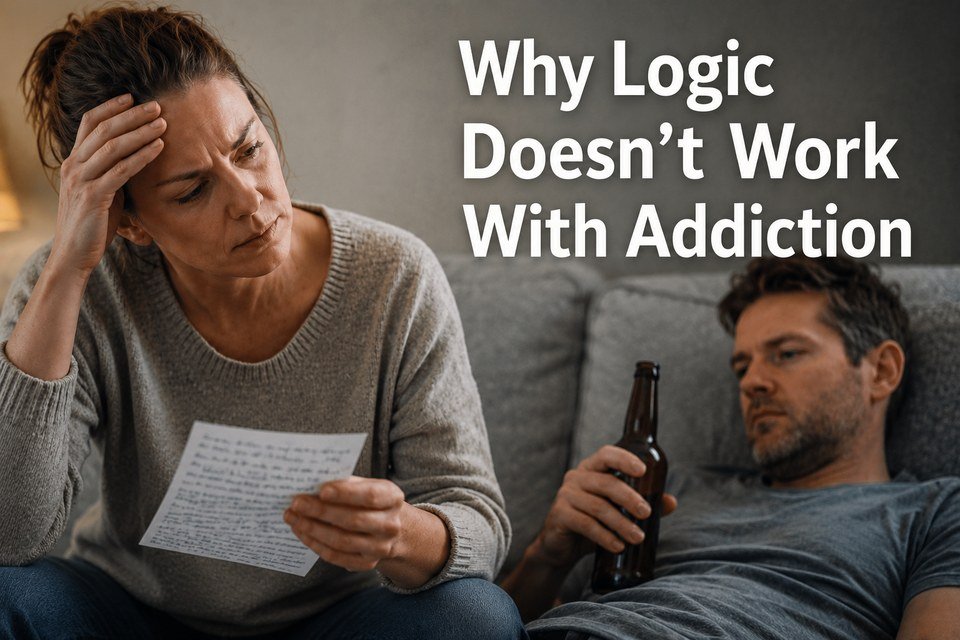
If love were enough, this wouldn’t be happening. If logic worked, your partner would have stopped the first time you explained it clearly. If consequences landed the way they “should,” none of this would still be going on.
And yet — here you are.
Still loving. Still hoping. Still trying to explain something that feels painfully obvious.
So let’s say it plainly:
Addiction does not respond to logic the way healthy minds do.
And that’s not because you’re bad at explaining — it’s because addiction doesn’t speak the language you’re using.
“If Love Were Enough…”
Most women I work with start here.
“If they loved me enough, they’d stop.”
“If they cared about the kids, they’d change.”
“If our life mattered to them, this wouldn’t be happening.”
It makes sense. In a healthy brain, love motivates change.
In a healthy system, values guide behaviour.
But addiction isn’t a values problem.
It’s not a love problem.
And it’s not a logic problem.
Addiction hijacks the brain’s survival wiring.
It moves substance or behaviour into the same category as oxygen and water.
That means when addiction is active, the brain is no longer asking:
“What do I value most?”
It is asking:
“What will stop this discomfort right now?”
And in that moment, love — even real love — gets drowned out by urgency.
Not because you don’t matter.
But because addiction doesn’t play fair.

Why Your Best Arguments Fail
You’ve probably tried:
- Calm explanations
- Emotional pleas
- Facts and consequences
- Promises of support
- Tears
- Boundaries you didn’t want to set
- Threats you didn’t want to make
And still, it continues.
Not because you didn’t say it right.
But because you’re talking to the part of the brain that isn’t driving the bus anymore.
When addiction is in control:
- Long-term thinking shuts down
- Emotional regulation collapses
- Shame increases — and fuels more use
- Fear doesn’t motivate change, it triggers escape
So when you say:
“Can’t you see what this is doing to us?”
Their nervous system hears:
“I’m failing. I’m trapped. I need relief.”
And addiction answers that fear faster than you ever could.
You’re speaking in reason.
Addiction replies in urgency.
Different languages. No translator.

“But I’ve Explained It So Clearly…”
Yes. You probably have.
You’ve said it kindly.
You’ve said it fiercely.
You’ve said it through tears at 2am.
And it still didn’t land.
That doesn’t mean you weren’t heard.
It means hearing didn’t equal choosing.
Understanding something and being able to act on it are not the same when addiction is active.
You can intellectually know something is ruining your life
…and still reach for it tomorrow.
That’s not weakness.
It’s dependency.

Why Consequences Sometimes Look Cruel (But Aren’t)
This is where things get really hard.
Because at some point, many women realise:
Talking isn’t changing anything.
And that’s when boundaries and consequences start to appear — not as punishments, but as survival tools.
Things like:
- Not covering for them
- Not paying their debts
- Not rescuing them from every crash
- Saying “no” even when it hurts
- Choosing your own safety, sanity, and stability
From the outside — and sometimes from inside your own heart — this can look cruel.
But here’s the truth:
Protecting yourself is not cruelty.
Stopping enabling is not abandonment.
Letting reality speak is not the same as causing harm.
Consequences don’t exist to teach lessons.
They exist because you are allowed to have a life.
Sometimes they are the only thing louder than addiction.
Sometimes they change nothing.
But they are never wrong when they are chosen to protect you.
The Real Trap: Thinking You’re the Missing Piece
Many women secretly believe:
“If I could just say it better… love better… support better… understand better… then this would change.”
That belief feels hopeful.
But it’s also heavy.
Because it puts the entire weight of someone else’s illness on your back.
You didn’t cause this.
You can’t cure this.
And you can’t logic someone out of a nervous system that’s fighting for relief.
You are allowed to stop trying to be the solution.
If This Feels Familiar
If you’re exhausted from explaining, pleading, reasoning, begging, and hoping…
You’re not failing.
You’re just using tools that addiction doesn’t respond to.
And that doesn’t mean you stop loving.
It means you stop believing love is a lever.
Love is not leverage.
Love is not control.
Love is not a cure.
Sometimes love stays — and steps back.
Sometimes love says, “I can’t live like this anymore.”
Sometimes love looks like choosing yourself.
Not sure what to do next?
Start with The List — my free short training designed to help you separate what is within your control from what is not, see where helping may have become rescuing, and begin making clearer decisions about what happens next.
You do not need to solve everything today.
You only need to take the next honest step.

Want to Go Deeper?
Knowing that logic alone will not make someone change can leave you wondering what, if anything, you can do instead. In What Can I Do to Make My Loved One Stop Drinking or Using Drugs?, I explain the difference between control and influence, what may genuinely help, and how to respond without taking responsibility for their recovery.
If this post hit close to home, you might also want to read:
- Why Won’t They Stop? Understanding Addiction Without Blaming Yourself
- Am I Helping or Enabling? A Compassionate Look at a Painful Question
- Why Loving Someone With Addiction Is So Exhausting (And Why It’s Not Your Fault)
And if you’re ready to stop carrying this alone, there’s support waiting for you — without judgment, pressure, or fixing.
You don’t have to solve addiction.
You just have to decide how you want to live alongside it — or not.